
LLM vs. RAG vs. AI Agents vs. MCP: Architecture Roles
Compare LLMs, RAG, AI agents, and MCP by role: generation, retrieval, action control, protocol integration, limits, and combinations.
Abstract
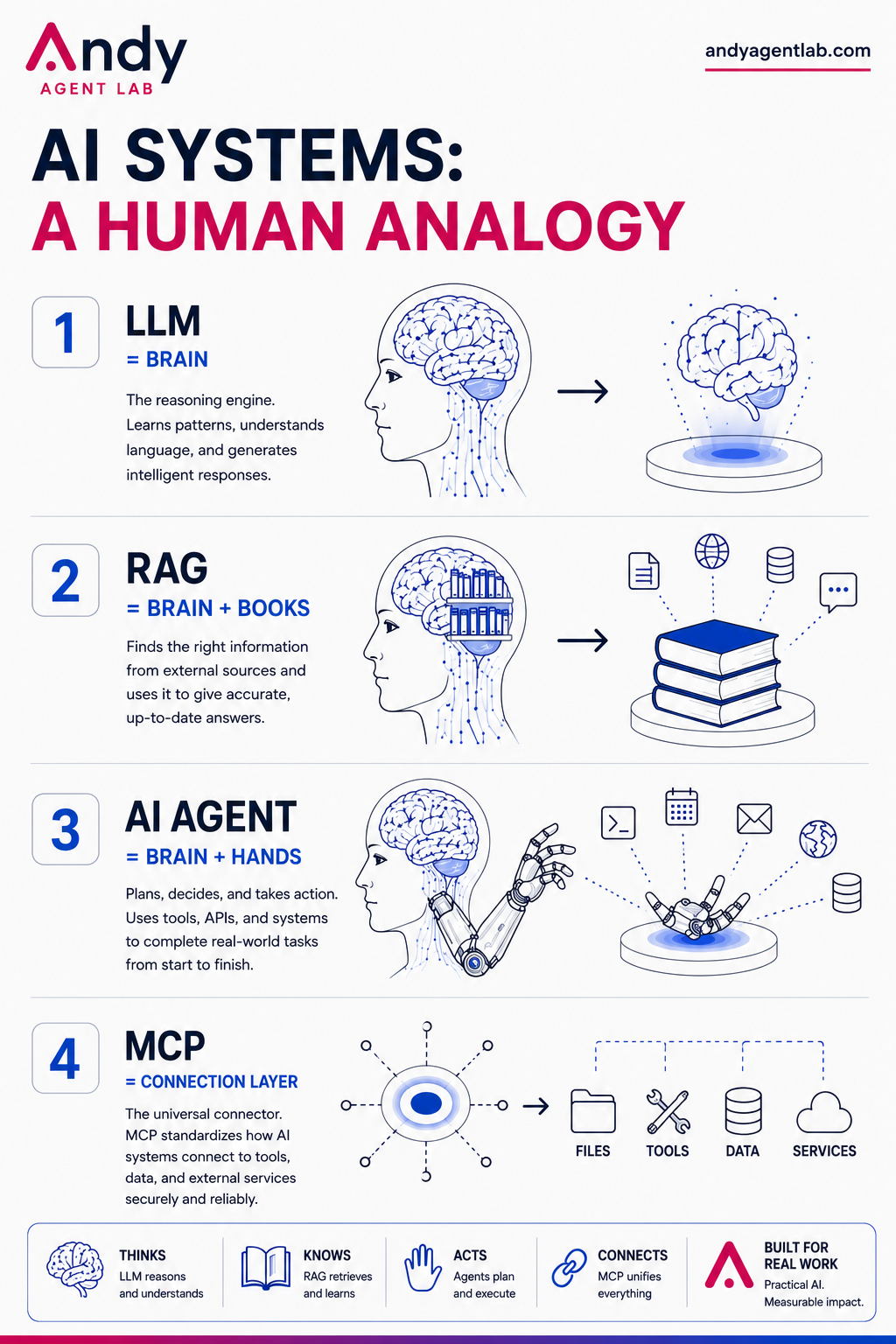
LLM, RAG, AI agent, and MCP are often presented as four steps in one progression: a model thinks, retrieval gives it knowledge, an agent gives it the ability to act, and MCP connects everything. That explanation is useful as a first analogy, but it collapses four different kinds of technical object.
An LLM is a trained model. RAG is a retrieval-and-generation architecture pattern. An AI agent is a goal-directed system that can select and execute actions over multiple steps. MCP is a versioned communication protocol for exposing context and capabilities between applications and servers. They can be combined, but none is automatically the next version of another.
This article keeps the human analogy as a teaching aid while defining the technical boundary of each term. It also identifies what each component does not establish: an LLM is not a human brain, retrieval is not learning or verification, tool access alone does not prove agentic control, and MCP does not make an integration secure or agentic by itself.
The short version
| Term | Technical type | Primary function | What it does not establish |
|---|---|---|---|
| LLM | Trained statistical language model | Produces token probabilities and generated output from supplied context and learned parameters [1][3] | External retrieval, persistent application memory, tool execution, or factual verification |
| RAG | Retrieval-and-generation pattern | Retrieves external records or passages and conditions generation on them [4][5] | That the retrieved material is correct, complete, current, or faithfully used |
| AI agent | Goal-directed software system | Selects actions, uses observations, and continues or stops according to a control process [6][7][8] | That every decision is correct, authorized, or safe |
| MCP | Open, versioned protocol | Standardizes communication between an LLM application and servers exposing context or capabilities [11][12] | A model, retrieval strategy, agent controller, business integration, or complete security boundary |
These descriptions operate at different abstraction levels. The LLM is a model component; RAG is a way to augment a model invocation; an agent is a larger execution system; MCP is one possible interface between system components.
Terminology scope: not every term has one universal boundary
The four labels do not have identical standards status.
- Large language model (
LLM) is an established technical category. The formal sources used here describe model scale and architecture without establishing one cross-industry numeric cutoff for the term, so this article does not assign a fixed parameter or dataset-size threshold [1][3]. - Retrieval-augmented generation (
RAG) was named and formalized by Lewis et al. for models combining parametric and non-parametric memory. The original implementation used a dense Wikipedia index and a neural retriever; later evaluated RAG systems also use other retriever and generator combinations [4][5]. - AI agent has no single universally enforced systems boundary. NIST describes agents in terms of autonomous decision-making and action with limited human supervision, while architecture literature adds memory, action spaces, observations, and a decision process [6][7][8]. This article uses a narrow operational definition and distinguishes agents from fixed workflows.
- Model Context Protocol (
MCP) is a formal protocol name governed by a versioned specification. As of July 19, 2026, the latest published specification is version2025-11-25[11].
1. LLM: the “brain” analogy
What the analogy gets right
Calling the LLM the “brain” indicates that it is often the component responsible for interpreting language input and producing language output. In a larger application, the model may also generate classifications, proposed plans, structured arguments, or candidate tool calls [10].
Where the analogy breaks
“Brain” is not a technical description of an LLM and should not be read as evidence of human cognition, awareness, intent, or understanding. NIST explicitly identifies inappropriate anthropomorphism as a risk in human–AI configurations [1]. A safer systems statement is that an LLM performs learned statistical computation over tokens and can produce behavior that is useful on language and reasoning tasks.
Technical definition
A language model assigns probabilities to token sequences. One common generative design is autoregressive: given a sequence of prior tokens, the model estimates a probability distribution for the next token. Generation repeats that operation until a stopping condition is reached [1][3].
The Transformer introduced an attention-based neural architecture that became foundational to many modern language models [2]. GPT-3 is one documented example of a large autoregressive language model: Brown et al. describe a model with 175 billion parameters applied to tasks through text input without gradient updates at inference time [3]. NIST similarly explains that LLM outputs are produced through statistical prediction, such as predicting the next token or word [1].
Training and inference are different operations
The distinction between training and inference is essential:
- Training adjusts model parameters from data according to an optimization objective.
- Inference applies the trained parameters to the current input to calculate an output.
- In-context information influences the current invocation without, by itself, updating the model parameters [3].
This is why supplying a document, retrieving a passage, or adding a tool result to the prompt is not the same operation as training the model on that information.
A simplified inference path
For the conventional autoregressive text-model design described above, the application-level path is approximately [1][3]:
- The application assembles the input context.
- Text is represented as tokens.
- The model calculates a probability distribution for the next token.
- A decoding procedure selects a token.
- The selected token is appended to the sequence.
- The process repeats until a stop condition is reached.
The input context may contain instructions, user messages, retrieved passages, tool results, or conversation state. Those surrounding components belong to the application or system architecture; they are not all properties of the base model.
For a detailed distinction between the visible user request and the wider information available during inference, see User Prompt vs. Model Context: What Information Reaches an LLM.
What an LLM does not provide by itself
An LLM alone does not establish:
- access to a current external source,
- durable memory across application sessions,
- permission to call an API or modify a record,
- a multi-step control loop,
- claim-level evidence or verification,
- or enforcement of authorization and business rules.
Products built around an LLM may add any of these capabilities. The distinction is between the model and the system that invokes it [1][8][10].
2. RAG: the “brain + books” analogy
What the analogy gets right
The “books” represent information outside the model parameters. RAG gives a generation system a retrieval path into an external collection so that selected material can be supplied during generation.
Where the analogy breaks
The books are not automatically authoritative, complete, current, or relevant. The retriever does not always find the “right” passage, and the generator does not necessarily use a retrieved passage faithfully. RAG can improve evidence access, but it is not a verification guarantee.
Technical definition
Lewis et al. define retrieval-augmented generation as a combination of parametric memory in a pretrained generation model and non-parametric memory in an external index accessed by a retriever [4]. In the original RAG implementation, the external memory was a dense vector index of Wikipedia and the generator was conditioned on retrieved passages.
The broader architectural idea is:
Retrieve information from a source outside the model parameters, then condition generation on the retrieved information.
A typical runtime path
A retrieval-grounded generation request commonly contains the following functions [4][5]:
- Query formation: derive a retrieval query from the user request or current task state.
- Retrieval: search an index or source and return candidate records or passages.
- Selection: choose which retrieved material enters the active context.
- Context assembly: combine the selected evidence with the instructions and user request.
- Generation: invoke the model using that assembled context.
- Optional validation: check citation alignment, source eligibility, or claim support.
The final validation step is optional because it is not inherent in the definition of RAG. If a system requires demonstrated factual support, it must add explicit evidence and validation controls.
Retrieval is not the same as learning
The statement “RAG retrieves and learns” conflates two different mechanisms.
- Retrieval reads from an external source at runtime.
- Learning or training changes model parameters or another learned component.
An implementation may train or fine-tune its retriever and generator, as the original RAG paper did. But retrieving a passage for one request does not, by itself, update the LLM’s parameters. It changes the input available for that inference [4].
What RAG can improve
When the source and retrieval pipeline are well controlled, RAG can provide:
- access to information not reliably represented in model parameters,
- a path to private or domain-specific material,
- easier source updates than retraining a base model,
- and evidence that can be attached to an answer.
These are architectural possibilities, not automatic outcomes [4].
What RAG does not guarantee
RAG can fail at both major stages:
- retrieval failure: the relevant evidence is not returned, an irrelevant passage is ranked highly, or the source collection is incomplete;
- generation failure: the model ignores, misreads, overgeneralizes, or contradicts the retrieved evidence.
RAGChecker, a NeurIPS evaluation framework, separates retrieval and generation diagnostics precisely because end-to-end answer quality can hide failures in either component [5]. A professional RAG system therefore requires evaluation of the retriever, the generator, and the alignment between generated claims and retrieved evidence.
3. AI agent: the “brain + hands” analogy
What the analogy gets right
The “hands” represent the ability to affect an environment. In software systems, those actions may include querying a database, calling an API, performing a computation, writing or debugging code, or managing email and calendar operations [6][14].
Where the analogy breaks
An agent is not simply an LLM with a tool attached. Tool availability establishes a possible action surface; it does not establish who chooses the next action, how state is maintained, how results affect later decisions, or where execution is authorized [8][10].
Operational definition used here
NIST’s 2026 concept paper describes software and AI agents as systems capable of autonomous decision-making and action, operating with limited human supervision to achieve complex goals [7]. NIST’s AI Agent Standards Initiative similarly centers autonomous action performed on behalf of users [6].
For this article, an LLM-based AI agent is:
A goal-directed software system in which a model participates in selecting actions over one or more steps, receives observations from the environment, and uses those observations to determine what to do next or when to stop.
This is an operational definition, not a claim that every organization uses the word “agent” in exactly the same way. Anthropic, for example, explicitly notes that the term is used for both autonomous systems and prescribed workflows, then distinguishes fixed workflows from systems in which the model dynamically directs its process and tool use [10].
Core system functions
Agent implementations vary, but the architecture literature identifies several recurring functions:
- Goal or task state: what the system is trying to accomplish.
- Working state or memory: information carried across decision steps.
- Decision process: logic for choosing the next action.
- Action space: the internal and external actions available to the system.
- Grounding interfaces: mechanisms for interacting with an external environment.
- Observations: results returned after an action.
- Control conditions: permissions, budgets, approvals, error handling, and stop rules.
CoALA describes language agents using modular memory, a structured action space, and a generalized decision-making process [8]. ReAct demonstrates a narrower loop in which language-model reasoning and external actions are interleaved so that observations from the environment can affect later steps [9]. Anthropic’s implementation guidance adds stopping conditions, environmental feedback, and optional human checkpoints [10].
A simplified agent loop
At the system level, a bounded agent loop can be represented as follows [8][9][10]:
- Receive the task and current state.
- Select or propose a next action.
- Validate and authorize the proposed action.
- Execute the action through an external tool or service.
- Record the resulting observation.
- Update the working state.
- Continue, request human input, fail, or stop.
The model may propose an action, but application code normally performs the external call [10][14]. This separation matters because the component that generates an action proposal is not necessarily the component that has authority to execute it.
Not every LLM workflow is an agent
Under the narrow definition used here, and following the workflow–agent distinction in Anthropic’s implementation guidance [10]:
| System behavior | More precise description |
|---|---|
| One prompt produces one response | LLM application |
| Retrieval runs and the LLM answers from the returned passages | RAG application |
| Code follows a fixed, predefined sequence of model and tool calls | LLM workflow |
| The model chooses among actions and adapts subsequent steps to observations | Agentic system |
NIST’s 2026 agent identity concept paper makes a related scope distinction: it treats architectures that dynamically acquire context, process results, and potentially take action as agentic, while excluding RAG-only and LLM-only architectures from that project’s scope [7].
4. MCP: the “connection layer” analogy
What the analogy gets right
MCP is a connection protocol. It standardizes how an LLM application can communicate with servers that expose contextual information or capabilities.
Where the analogy breaks
“Universal connector” is too broad. MCP defines one protocol surface; it does not automatically implement every underlying API, normalize every business object, choose a retrieval strategy, or decide which action should run. An MCP server still needs code that maps protocol requests to the relevant files, databases, tools, or services [11][12].
Formal definition
The official specification defines MCP as an open protocol for integrating LLM applications with external data sources and tools [11]. The 2025-11-25 specification uses JSON-RPC 2.0, stateful connections, protocol-version negotiation, and capability negotiation.
MCP uses a host–client–server architecture [12]:
- Host: the LLM application that coordinates integrations and creates clients.
- Client: the protocol component that maintains an isolated connection to one server.
- Server: a service that exposes context or capabilities through MCP primitives.
What MCP can expose
The current specification includes several protocol features. Three central server-side primitives are:
- Resources: data that a server exposes to a client, such as files, database schemas, or application-specific information. The host application determines how those resources enter the model context [13].
- Tools: named operations with schemas that can be discovered and invoked through the protocol, such as querying a database, calling an API, or performing a computation [14].
- Prompts: server-provided prompt templates and arguments that a client can expose to users or applications [16].
MCP also defines connection lifecycle and capability negotiation so that clients and servers can establish version compatibility and declare supported features [11][12].
What MCP does not provide
MCP is not:
- an LLM,
- a RAG pipeline,
- an agent planner or controller,
- an authorization policy for every connected service,
- a guarantee that a tool result is correct,
- or a guarantee that an integration is secure.
The specification warns that MCP can enable arbitrary data-access and code-execution paths that implementers must secure [11]. Its HTTP authorization mechanism is optional, and the specification separately defines how supported implementations should perform authorization [15]. Permissions, consent, credential handling, tool-level policy, and business authorization remain implementation responsibilities.
MCP does not make a system agentic
An ordinary chat application can use MCP to read a resource without operating as an agent. A deterministic workflow can call an MCP tool along a fixed path. An agent can use MCP tools dynamically, but it can also use direct APIs or other tool interfaces.
MCP standardizes a communication boundary. Agentic behavior depends on the control process built around that boundary.
How the four fit together
The most reliable way to distinguish the terms is to ask which architectural question each one answers.
| Architectural question | Relevant term |
|---|---|
| Which trained model transforms the current context into generated output? | LLM |
| How does external evidence enter the generation request? | RAG |
| Which system selects actions, uses observations, and controls multi-step progress? | AI agent |
| Which protocol can standardize access to exposed context and capabilities? | MCP |
They can appear in several valid combinations:
| Composition | What it describes |
|---|---|
| LLM only | Generation from the supplied input and learned parameters |
| LLM + RAG | Generation conditioned on retrieved external material |
| LLM + fixed tool workflow | A predetermined application path that includes tool calls |
| AI agent + direct APIs | A model-influenced control loop using service-specific integrations |
| AI agent + MCP | A model-influenced control loop using capabilities exposed through MCP |
| AI agent + RAG + MCP | A larger system in which retrieval supplies evidence, the agent controls steps, and MCP provides one or more standardized integration surfaces |
The presence of more components does not automatically make a system better. Each additional component introduces separate quality, security, latency, observability, and governance requirements [10][11].
A reference composition
Consider a system requirement with two distinct outcomes: answer a question from an approved document collection and, only when authorized, perform an external action.
The component boundaries would be:
- RAG retrieves eligible passages from the approved collection.
- The LLM generates an answer conditioned on the request and retrieved passages.
- If an action is required, the agent controller determines the next step from the task state and available observations.
- The application validates and authorizes the proposed action.
- A tool performs the external operation through a direct integration or an MCP server.
- The result returns as an observation that the agent can use in the next decision step.
This composition keeps four responsibilities separate: generation, retrieval, control, and protocol communication.
Common misconceptions
| Misconception | Technical correction |
|---|---|
| “The LLM is the entire AI system.” | The LLM is one model component. The application may add instructions, state, retrieval, tools, policies, and orchestration. |
| “An LLM retrieves the facts it knows.” | Autoregressive generation calculates token probabilities; it is not equivalent to querying a structured factual database. |
| “RAG teaches the model new information.” | Retrieval supplies external context for inference. Parameter learning is a separate operation. |
| “RAG guarantees accurate and current answers.” | Accuracy depends on source quality, freshness, retrieval, context assembly, generation, and validation. |
| “Any tool call makes the application an agent.” | Tool use can be fixed or dynamic. Agentic control concerns how actions are selected and revised from observations. |
| “MCP is the agent.” | MCP is a communication protocol. It does not supply the model, task state, decision loop, or execution policy. |
| “MCP makes integrations secure.” | MCP defines protocol and optional authorization mechanisms; secure deployment still requires correct permissions, consent, validation, credential handling, and service-side enforcement. |
| “LLM, RAG, agent, and MCP are four maturity levels.” | They describe different component or system types and can be combined independently according to the required architecture. |
Practical selection guide
Use the requirement—not the popularity of a term—to identify the necessary component:
- If the system only needs to transform supplied context into language or structured output, an LLM invocation may be sufficient.
- If the answer must use an external document collection or knowledge source, add a retrieval path and evaluate it as a RAG system.
- If the system must dynamically choose and revise actions across multiple steps, define an agent control loop with state, observations, permissions, and stop conditions.
- If multiple applications or integrations need a shared protocol for exposing context and capabilities, evaluate MCP as an interface option.
The terms should describe implemented behavior. They should not be used as interchangeable labels for a product that merely includes an LLM.
Conclusion
The human analogy is useful only if its limits remain visible:
- LLM as “brain”: a language model performs learned statistical computation; it is not a human mind or a complete application.
- RAG as “brain + books”: retrieval supplies external context; it does not automatically learn, verify, or guarantee correctness.
- AI agent as “brain + hands”: an agent system selects and executes actions using state and observations; tool access alone is insufficient to define the control architecture.
- MCP as “connection layer”: MCP standardizes protocol communication; it does not provide the model, retrieval logic, agent loop, or security policy by itself.
The critical technical distinction is therefore not which term sounds more advanced. It is which responsibility belongs to the model, the retrieval layer, the agent controller, and the integration protocol—and which controls remain outside all four.
References
[1] NIST — Artificial Intelligence Risk Management Framework: Generative Artificial Intelligence Profile (NIST AI 600-1), 2024.
[2] Vaswani et al. — Attention Is All You Need, NeurIPS 2017.
[3] Brown et al. — Language Models are Few-Shot Learners, NeurIPS 2020.
[4] Lewis et al. — Retrieval-Augmented Generation for Knowledge-Intensive NLP Tasks, NeurIPS 2020.
[5] Ru et al. — RAGChecker: A Fine-Grained Framework for Diagnosing Retrieval-Augmented Generation, NeurIPS 2024.
[6] NIST — AI Agent Standards Initiative, updated 2026.
[7] NIST NCCoE — Accelerating the Adoption of Software and AI Agent Identity and Authorization: Concept Paper, draft, 2026.
[8] Sumers et al. — Cognitive Architectures for Language Agents, 2023.
[9] Yao et al. — ReAct: Synergizing Reasoning and Acting in Language Models, ICLR 2023.
[10] Anthropic — Building Effective Agents, 2024.
[11] Model Context Protocol — Specification, version 2025-11-25.
[12] Model Context Protocol — Architecture, version 2025-11-25.
[13] Model Context Protocol — Resources, version 2025-11-25.
[14] Model Context Protocol — Tools, version 2025-11-25.
[15] Model Context Protocol — Authorization, version 2025-11-25.
[16] Model Context Protocol — Prompts, version 2025-11-25.