
Tool-Using LLM Systems: Privilege Bleed and Integrity-Signal Failures
Two control-plane failure patterns that let untrusted state steer tool execution across steps in multi-step LLM systems.
What this page is: an audit-oriented model and test checklist for multi-step, tool-using LLM systems.
What this page is not: a claim about any specific vendor trace or internal architecture.
Executive summary
This article defines two control-plane failure patterns that recur in audits of multi-step, tool-using LLM systems:
| Pattern | Failure mode | Typical impact | Minimum bar (“good”) |
|---|---|---|---|
| 1) Privilege persistence across interaction boundaries | Authorization context is treated as carryover state instead of being re-validated per tool call | Cross-thread/tab/conversation privilege bleed; writes in the wrong boundary | Per-call authorization + server-side enforcement; credentials bound + scoped + short-lived |
| 2) Non-enforcing integrity signals | Integrity risk is detected but execution state does not change (“detect without enforcement”) | Tainted artifacts continue to influence routing/tools across steps | High-risk signals trigger enforcement actions (hold/deny/quarantine) + circuit breakers |
Evidence boundary: the patterns are vendor-agnostic; the references are standards/guidance used to define terms and testable controls.
Scope and terminology
This article focuses on control-plane failures in systems where an LLM participates in a multi-step controller loop and can invoke tools/connectors.
System model (terminology used here)
- Control plane: the policy and orchestration layer that decides what may happen and enforces it: identity/session binding, context construction, routing/selection, tool authorization, integrity checks, and enforcement actions.
- Data plane: the side effects produced by tools/connectors (API calls, writes, state changes).
This aligns with the control-plane/data-plane framing in NIST SP 800-207, Zero Trust Architecture.
PDP vs PEP (decision vs enforcement)
- Policy decision point (PDP): the component(s) that decide allow/deny for a proposed step/action.
- Policy enforcement point (PEP): the component that enforces allow/deny before any side effect (tool execution).
NIST SP 800-207 separates policy-decision responsibilities from policy-enforcement responsibilities in its Zero Trust Architecture model.
Principle anchors (security engineering)
- Complete mediation: every access must be checked for authority.
- Fail-safe defaults: default deny unless explicitly permitted.
These principles come from Saltzer and Schroeder’s The Protection of Information in Computer Systems.
Interaction boundary (terminology used here)
An interaction boundary is a user-visible separation such as thread/tab/conversation/workspace.
A UI boundary is not a security boundary unless the backend and tool gateway treat it as a boundary for authorization and state.
Integrity signal (terminology used here)
An integrity signal is any detection output that indicates a risk of tainted inputs/state (e.g., poisoned retrieval, suspicious tool output, policy-violating arguments).
A signal is only useful for preventing harm if it can change execution state (hold/deny/quarantine).
Concrete schematic (example)
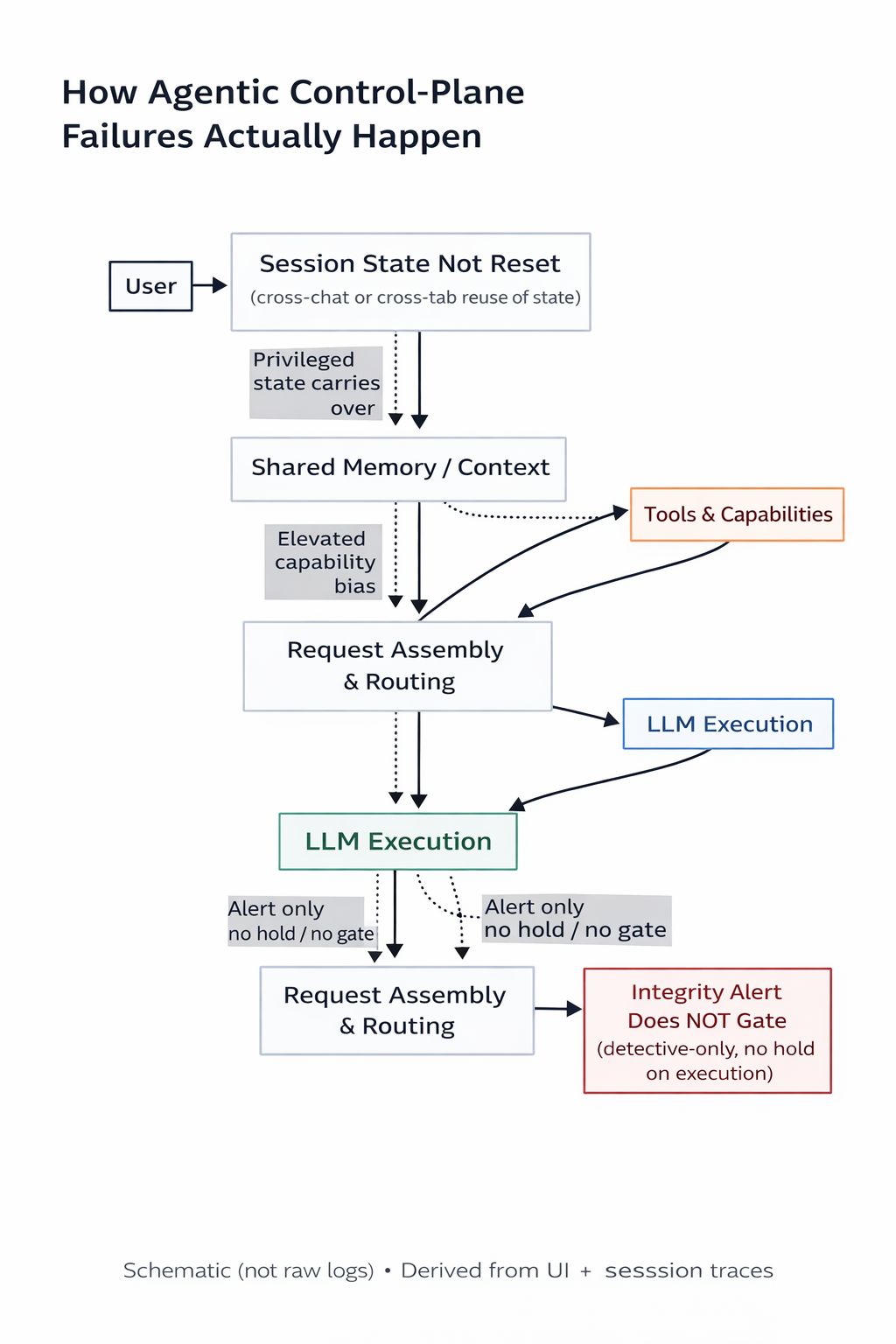
Pattern 1 — Privilege persistence across interaction boundaries
Definition (failure mode)
Privileged authorization context (identity binding, tool scopes, “write-capable” mode, or equivalent) persists across an interaction boundary because the system does not enforce a hard server-side boundary at the PDP/PEP layer.
The Effective Privileges: Provenance and Replay Failure Diagram isolates this invariant: effective privileges must derive from server authorization and authoritative state, not from chat-derived context, model output, memory, logs, or prior UI state.
Why it matters (testable impact)
If authorization becomes implicit carryover state, the system stops enforcing complete mediation at the moment it matters most: the next tool call.
That converts “allowed to write” from a per-call decision into cached context that can drift across steps and boundaries.
Common root causes (audit targets)
- A single tool/connector credential is reused across multiple boundaries without binding it to the subject and boundary (e.g.,
principal_id+conversation_id/thread_id). - An allow decision (“write-capable”) is cached without invalidation on boundary changes, privilege drops, or TTL expiry.
- Client/UI state is treated as authoritative for tool access rather than enforcing authorization at a server-side gateway/PEP.
Controls (minimum bar)
- Hard boundary on interaction switch: privileged modes reset on boundary change; write-capable operations require re-authorization in the target boundary.
- Bound, scoped, short-lived credentials: mint per principal (and per boundary when applicable), minimal scope (read vs write separated), short TTL.
- Per-call authorization (PDP → PEP): every tool invocation is authorized and enforced server-side before side effects.
- Least privilege by construction: minimize tool surface and default to read-only where feasible.
Authorized regression tests
1) Cross-boundary privilege bleed: authorize writes in Boundary A → switch to Boundary B → attempt a write.
Expected: deny/hold unless Boundary B re-authorizes.
2) Credential binding replay: replay a valid credential from Boundary A in Boundary B.
Expected: deny (binding mismatch).
3) Authority change mid-session: revoke role/scope → repeat the same write.
Expected: deny on the next call (no stale authorization).
Pattern 2 — Non-enforcing integrity signals
Definition (failure mode)
The system detects integrity risk (tainted context, anomalous memory, suspicious tool output, policy-violating arguments) but continues execution (“alert only”), allowing flagged artifacts to re-enter context and influence later steps.
Why it matters (testable impact)
In multi-step controller loops, contaminated artifacts can influence:
- routing/tool selection,
- argument construction,
- subsequent LLM steps.
A monitoring-only signal does not reduce the likelihood of side effects if execution proceeds unchanged.
Common root causes (audit targets)
- Integrity checks run after tool selection or argument construction (too late in the lifecycle).
- Alerts exist but there is no execution-state transition (no hold/quarantine/deny path).
- No circuit breaker: repeated integrity signals still allow retries, increasing exposure.
Controls (minimum bar)
- Fail-safe defaults for high-risk signals: prefer hold/deny over “continue”; require explicit approval to resume.
- Quarantine tainted artifacts: flagged memory/retrieval/tool outputs are prevented from re-entering context until reviewed/replaced.
- Circuit breakers: repeated integrity violations stop execution or degrade to read-only; write intent requires operator approval.
- Pre-execution validation: validate tool selection + arguments (schema + semantic constraints) before side effects (PEP pre-execution).
Authorized regression tests
1) Poisoned-input enforcement: inject an untrusted chunk that triggers an integrity rule.
Expected: step is held/blocked and artifact is quarantined.
2) Policy-violating arguments: craft model output that violates a scope/tenant/resource constraint.
Expected: rejected by the PEP before tool execution.
3) Repeated-signal circuit breaker: trigger the same integrity signal N times.
Expected: execution stops or degrades to read-only.
Test matrix (copy/paste)
| Pattern | Test | Expected enforcement point | Expected result |
|---|---|---|---|
| 1 | Cross-boundary privilege bleed | PEP (server-side) | Deny/hold unless boundary re-authorizes |
| 1 | Credential binding replay | PEP (server-side) | Deny on binding mismatch |
| 1 | Authority change mid-session | PDP+PEP on next call | Deny on next invocation |
| 2 | Poisoned input triggers rule | Controller enforcement / PEP | Hold/deny + quarantine artifact |
| 2 | Policy-violating args | PEP pre-execution | Reject before side effect |
| 2 | Repeated integrity signals | Circuit breaker | Stop or degrade to read-only |
Minimal audit checklist (copy/paste)
- Is privileged context invalidated on interaction boundary change (and via TTL)?
- Are credentials scoped to least privilege and bound to the right subject (and boundary where applicable)?
- Is every tool call authorized per call (PDP) and enforced pre-side-effect (PEP), not inferred from UI/session carryover?
- Do integrity signals change execution state for high-risk cases (hold/deny/quarantine), rather than only alert?
- Is there a circuit breaker for repeated integrity violations (stop / degrade / require approval)?
- Are tool arguments validated (schema + semantic constraints) before any side effect?
References
- OWASP Cheat Sheet Series — AI Agent Security Cheat Sheet: https://cheatsheetseries.owasp.org/cheatsheets/AI_Agent_Security_Cheat_Sheet.html
- OWASP — Securing Agentic Applications Guide 1.0: https://genai.owasp.org/resource/securing-agentic-applications-guide-1-0/
- OWASP — Top 10 for LLM Applications (2025): https://genai.owasp.org/llm-top-10/
- NIST SP 800-207 — Zero Trust Architecture (PDP/PEP; PE/PA; control plane vs data plane): https://doi.org/10.6028/NIST.SP.800-207
- NIST SP 800-53 Rev. 5 — Security and Privacy Controls: https://doi.org/10.6028/NIST.SP.800-53r5
- Saltzer & Schroeder (1975) — The Protection of Information in Computer Systems: https://www.cl.cam.ac.uk/teaching/1011/R01/75-protection.pdf
Suggested reading
- Orchestration risk (controller loop): The Attack Surface Isn’t the LLM — It’s the Controller Loop
- Connected apps, scope, and approval surfaces: Connected Apps Expand the Capability and Authorization Surface of LLM Systems
- Request construction checkpoints: Request assembly threat model: reading the diagram
- Trust boundary audit checklist: Agentic Systems: 8 Trust-Boundary Audit Checkpoints
- Procedure (enforcement gate): Engineering Quality Gate — Procedure