
Cognitive Closure in AI Use: Why We May Stop Too Soon
Explore cognitive closure in AI use, its possible role in premature acceptance, and how evidence-based iteration supports answer evaluation and correction.
Introduction
Receiving an answer creates a decision: is the work complete, or does the result still need examination?
In AI-assisted work, that decision matters whenever the task requires more than producing text. A research conclusion needs adequate evidence. A summary needs to preserve the source’s meaning and important qualifications. A proposed solution needs to satisfy the conditions under which it will be used. An answer can be available while one of these requirements remains unresolved.
This article develops a specific thesis: the need for cognitive closure may encourage users to accept an AI answer before completing the evaluation and feedback needed to improve it. Once the question feels settled, the user may stop looking for omissions, testing assumptions, or supplying corrections. The opportunity for a useful next iteration is then lost.
The focus is the interaction between a human stopping decision and a process of evaluation and revision. Here, an iteration means a further cycle in which the user and system examine the current result, introduce relevant feedback, and assess any revision.
The discussion develops this conceptual account through established closure theory, research on engagement with AI, and evidence about language-model correction.
1. What the Need for Cognitive Closure Means
The need for cognitive closure is the motivation to obtain a definite answer to a question and resolve uncertainty. It can influence both the information a person considers before deciding and their willingness to reconsider afterward.
How urgency and permanence shape judgment
Kruglanski and Webster distinguish two tendencies:
- Urgency is the inclination to reach closure quickly. It can encourage seizing: adopting readily available information as the basis for a judgment, with limited exploration of alternatives.
- Permanence is the inclination to maintain closure once reached. It can encourage freezing: retaining an accepted judgment and resisting information that could require its revision.
The point at which a tentative idea becomes an accepted judgment matters. Before that point, someone seeking closure may actively search for information that can settle the question. Afterward, they may resist further examination because it could reopen the uncertainty. Kruglanski and Webster, 1996.
A motivation that depends on the person and the situation
People differ in their general preference for closure, but its strength also changes with circumstances. Time pressure, fatigue, and distracting noise can increase the need for closure by making continued information processing more difficult. Kruglanski, research overview.
When closure is premature
Reaching closure after an adequate assessment allows a decision to proceed. In this article, premature closure means treating a conclusion as settled and ending relevant inquiry before completing the checks needed to justify it for the task at hand. This includes leaving material contradictory evidence unexamined.
A sense of closure, as used here, is the experience of regarding a question as settled. That experience does not establish that the required assessment is complete.
An incorrect answer alone does not establish premature closure: errors can survive completed checks. Attributing an early stop to the need for closure also requires evidence about the person’s motivation.
2. How an AI Answer Can Become a Stopping Point
An AI answer can present a conclusion and reasons for it in the same response. Understanding that explanation and verifying the conclusion are separate operations. For a sourced claim, verification requires examining whether the cited material supports the claim’s wording and scope. For a recommendation, it requires checking whether the reasoning accounts for the relevant constraints.
From a candidate answer to an accepted conclusion
The proposed application of closure theory concerns when the user makes that acceptance decision. Seizing would occur when the user adopts the model’s conclusion because it provides a definite resolution, while the necessary checks remain incomplete. The answer has become a belief the user is prepared to rely on.
Freezing would concern preserving that belief. Examining a conflicting source or testing an alternative interpretation could require withdrawing the accepted conclusion and returning to uncertainty. A strong need to maintain closure may therefore reduce willingness to undertake those checks. This is the mechanism the article proposes for AI interactions, drawing on the distinction between acquiring and preserving closure in Kruglanski and Webster, 1996.
Evidence from human–GenAI collaboration
Han and colleagues studied metacognition—how learners monitor and regulate their own thinking—in 82 undergraduates working in 16 groups. Across three tasks over three weeks, they combined GenAI interaction metadata with self-reported need for closure to analyze metacognitive patterns.
Their institutional abstract reports that lower need for closure was associated with deeper, more reflective processing, while higher need for closure was associated with faster, goal-oriented strategies. This connects closure-related motivation with patterns of engagement in GenAI-supported learning. The abstract does not establish that these differences caused fewer verification steps, omitted iterations, or poorer final answers. Han et al., 2025.
A controlled test of accepting incorrect advice
Buçinca and colleagues tested 199 participants on a food-substitution task using experimentally controlled, simulated AI recommendations. One intervention required participants to make an initial decision before seeing the AI’s recommendation and explanation, after which they could revise their choice.
Across the cognitive-forcing conditions, participants were significantly less likely to follow an incorrect suggestion about which ingredient was highest in carbohydrates than in the simple explainable-AI conditions. This demonstrates that the interaction design can affect acceptance of incorrect advice in that task. The study did not test need for closure; its individual-difference measure was need for cognition, the motivation to engage in effortful thinking. It therefore provides related evidence about acceptance behavior, rather than a direct test of the proposed closure mechanism. Buçinca et al., 2021.
3. What a Useful Iteration Adds
To understand why stopping can matter, we need to identify the work that another iteration would perform.
A useful cycle has a specific object of evaluation: a claim, an assumption, a missing requirement, a calculation, or a proposed action. The user or system checks that object against an appropriate reference, brings the finding into the interaction, and evaluates whether the revision addresses it.
For factual work, the reference may be a source passage. For code, it may be an observed test result. For a summary, it may be a comparison with the original material. The value of the iteration lies in the information or evaluation it contributes.
How feedback can change the next output
CRITIC provides a concrete technical example. Its process generates an initial answer, checks aspects of that answer through external tools, and conditions a subsequent revision on the resulting critique. The authors reported improvements in their evaluated question-answering, mathematical program-synthesis, and toxicity-reduction tasks. The method operates through inference-time prompting and tool feedback without task-specific model training. Gou et al., 2024.
The relevant mechanism is that a later generation has access to findings from a check of the earlier output. In the human–AI workflow considered here, a user can contribute to that process by identifying a discrepancy, supplying a source, or clarifying a requirement. An objection becomes useful when it specifies what needs examination and provides a basis for assessing the result.
Checking the Han study illustrates this distinction. Its institutional abstract supports an association in an educational setting. A causal generalization beyond that finding would require additional evidence. A review can identify this specific gap and direct the revision toward an appropriately scoped conclusion. The revised wording can then be checked against the same source.
Repetition does not guarantee correction
Huang and colleagues evaluated intrinsic self-correction: models reviewing and revising their reasoning without external feedback. In the tested settings, performance declined, with some correct answers changed to incorrect ones. Their findings show why a change of answer must itself be evaluated. Huang et al., 2024.
An iteration therefore needs a purpose and an evaluation criterion. Asking for another answer creates another output; checking a specific weakness creates an opportunity to determine whether that weakness has been resolved.
4. Where Closure Can Interrupt the Improvement Process
The central thesis concerns a mismatch between the user’s readiness to finish and the work still required to evaluate the result.
The mechanism proposed here has three parts: a material issue remains unresolved, closure contributes to the decision to stop examining it, and that decision removes an opportunity for useful feedback or correction.
The answer is accepted before the gap is identified
If the response settles the question for the user, requirements may receive less scrutiny. A missing qualification or unsupported assumption can then escape attention because the comparison that would expose it never takes place.
At this stage, the issue is detection: the user has not yet identified anything to correct. The claim that a model was insufficiently challenged must therefore include what was left unexamined—such as the match between a conclusion and its cited evidence.
Relevant feedback never reaches the next iteration
After a gap is identified, the next step is to make it actionable. A source that contradicts a claim, an omitted requirement, or a failed check can guide a revision when it is brought into the process and used appropriately.
If acceptance occurs before that step, the particular correction opportunity is lost. The final artifact then retains an issue that has not been resolved. This is the sense in which the model is less challenged in this article: its output undergoes fewer substantive tests against evidence, assumptions, and task requirements.
This distinction also separates substantive iteration from continued conversation. A user could request changes in length or presentation while treating the underlying claims as settled. In that case, the relevant question is whether the content was re-examined, even though additional messages were exchanged.
The consequence concerns the delivered result
The proposed effect on quality is specific: an omission remains in a summary, a conclusion exceeds its evidence, or a required condition remains unaddressed. Each would need to be established by examining the actual result against its task requirements.
The claim concerns missed correction opportunities within the workflow. To establish that stopping produced a worse result, we would need a comparison showing that an appropriate continuation resolved the issue without introducing an equally material problem.
The full causal account remains a research proposition. Testing it would require measuring closure-related motivation, the checks and revisions users perform, and the quality of their accepted outputs, while accounting for task difficulty, available time, and domain knowledge. A short conversation alone cannot establish the motivation for stopping. The studies discussed above support parts of this account at different levels; they do not substitute for that combined test.
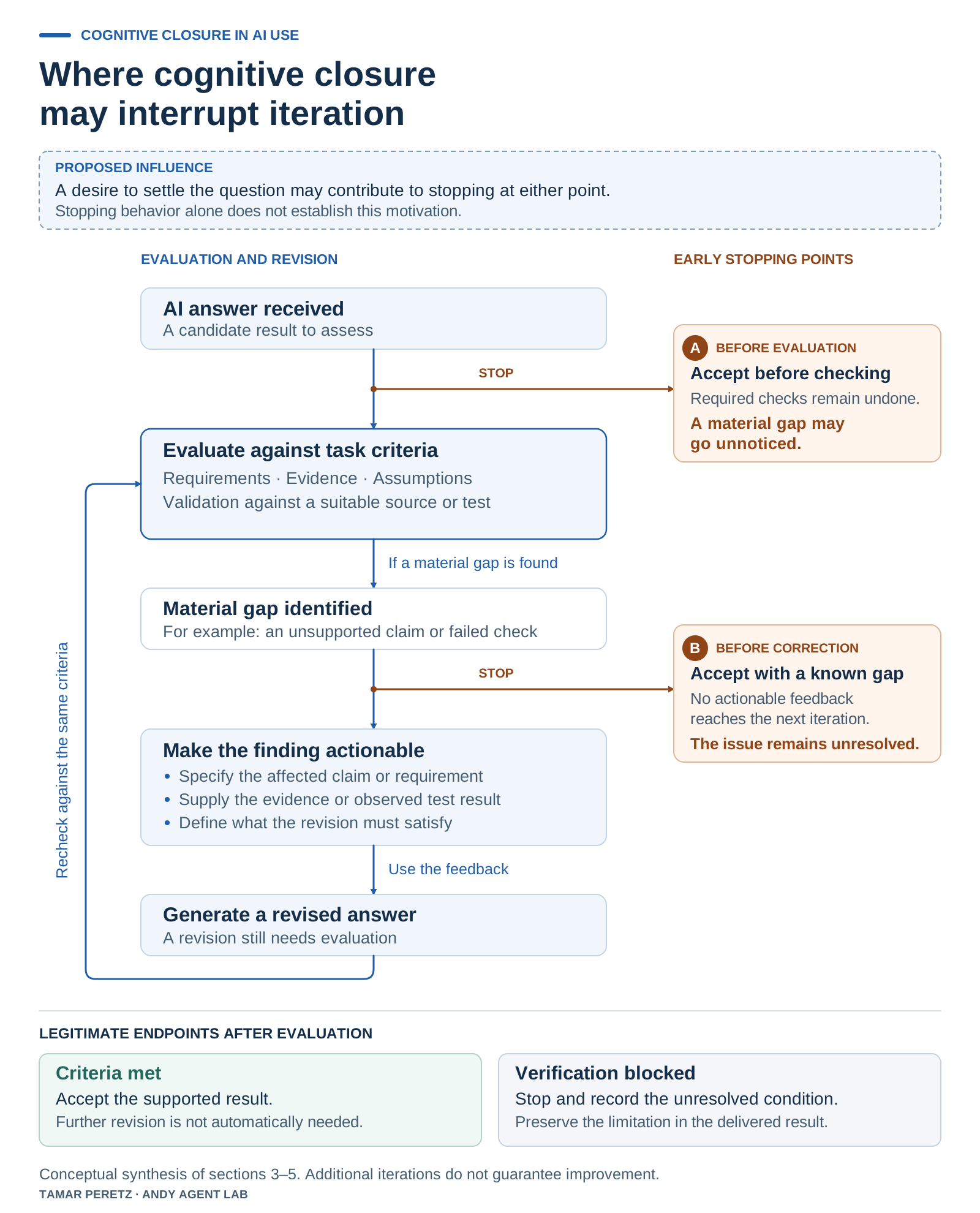
5. How to Decide Whether Another Iteration Is Needed
The practical implication proposed here is to make acceptance depend on explicit task criteria. This gives the stopping decision a basis that can be inspected.
Begin by identifying what would make the result usable. A research answer may require support for its central claims and appropriate qualification of its conclusion. A summary may require coverage of specified points and preservation of important exceptions. The criteria should reflect the actual task.
Then examine unresolved issues before deciding whether to continue:
| Check | What to establish | Reason to continue |
|---|---|---|
| Requirement coverage | The requested elements are present and sufficiently developed | A material requirement is missing or only partly addressed |
| Evidence | Central factual claims are supported by the permitted sources | A claim is unsupported, contradicted, or broader than its source |
| Assumptions | The conclusion uses premises appropriate to the task | An unverified premise could change the result |
| Validation | The relevant comparison, calculation, or test supports the result | A necessary check has not been performed or has failed |
When a check identifies a problem, define the next iteration around it. Specify the affected claim or requirement, the evidence or observation that motivates the correction, and the condition the revised answer must satisfy. Review the result against that condition before accepting it.
Keep the challenge open to either outcome. Evaluation should allow a supported answer to stand. Pressuring the model to change its conclusion solely because it has been challenged would replace one unsupported acceptance decision with another.
There is also a legitimate endpoint. If the relevant criteria are met, further conversation may serve no clear purpose. If verification cannot be completed because evidence, access, or expertise is unavailable, record the unresolved condition. Ending work under a constraint should preserve that limitation in the result.
6. Conclusion
Cognitive closure provides a theoretical basis for examining when a user decides that an AI answer is sufficient. Research on GenAI-supported learning links closure-related differences with patterns of cognitive engagement, while correction studies show why the content and evaluation of feedback matter.
The thesis developed here connects those observations: a motivation to settle the question may end an interaction before a necessary check or useful correction takes place. Its practical relevance lies in the decision to accept the current output.
For work that requires verification, that decision should be tied to the evidence examined, the requirements satisfied, and the limitations that remain. The number of messages is secondary to whether the necessary evaluation has occurred.
References
- Kruglanski, A. W., & Webster, D. M. (1996). Motivated closing of the mind: “Seizing” and “freezing”. Psychological Review, 103(2), 263–283. Author-hosted abstract.
- Kruglanski, A. W. (n.d.). The need for closure: Motivated closed mindedness. University of Maryland research overview.
- Han, Z., Ying, R., Huang, C., Tsai, C.-C., Wang, X., & He, T. (2025). Identifying students’ metacognition patterns by their needs for cognitive closure in human–GenAI collaboration. Computers & Education, 239, Article 105422. Study description and findings cited here were verified against the institutional abstract.
- Buçinca, Z., Malaya, M. B., & Gajos, K. Z. (2021). To trust or to think: Cognitive forcing functions can reduce overreliance on AI in AI-assisted decision-making. Proceedings of the ACM on Human-Computer Interaction, 5(CSCW1), Article 188. Author manuscript.
- Gou, Z., Shao, Z., Gong, Y., Shen, Y., Yang, Y., Duan, N., & Chen, W. (2024). CRITIC: Large language models can self-correct with tool-interactive critiquing. International Conference on Learning Representations.
- Huang, J., Chen, X., Mishra, S., Zheng, H. S., Yu, A. W., Song, X., & Zhou, D. (2024). Large language models cannot self-correct reasoning yet. International Conference on Learning Representations.