
Human Capabilities vs. AI Behavior: 26 Comparisons
Compare 26 human capabilities with human-like AI behavior: memory, reasoning, emotion and more. See how mechanisms differ and what the evidence supports.
Abstract
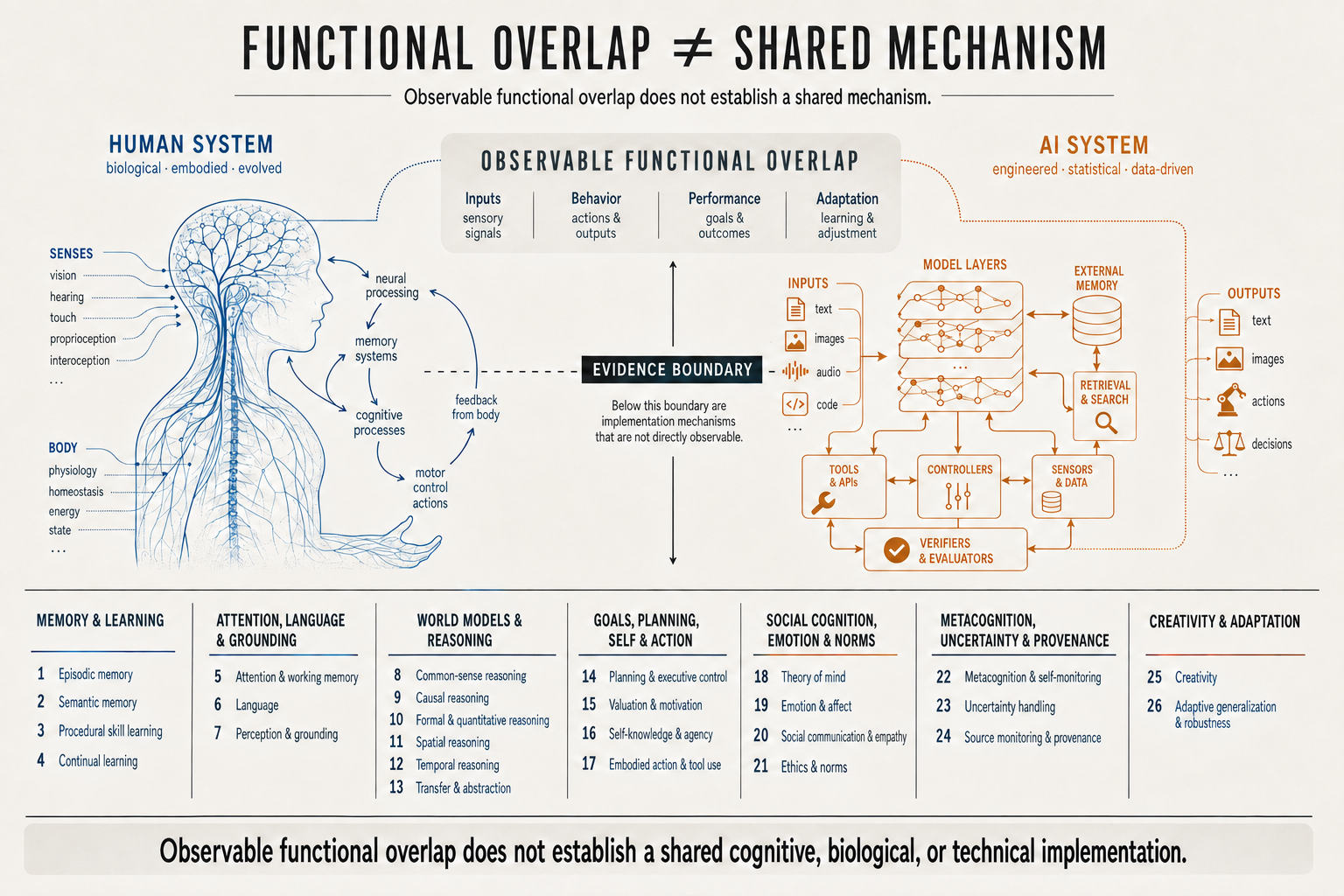
An AI system can answer a question about an earlier conversation, solve a reasoning problem, or generate an empathic response. These behaviors can overlap with human performance, but their cognitive, biological, and technical explanations must be evaluated separately.
The comparison asks what each system does, which processes support that result, and which claims remain unproven. Here, AI includes large language models (LLMs), multimodal models, and engineered systems with memory, tools, or physical control.
This article compares 26 capabilities across memory, learning, attention, language, perception, reasoning, planning, agency, emotion, social cognition, metacognition, action, and creativity. Each capability is analyzed through the same six layers:
- Human capability — what a person can do.
- Cognitive processes — the information-processing operations involved.
- Neurobiological and bodily implementation — the interacting neural, physiological, sensory, and motor systems that support those operations.
- Parallel AI behavior — the externally observable result an AI model or engineered AI system can produce.
- AI mechanism — the model, training process, memory, retrieval, tool, controller, sensor, or verifier that produces the result.
- Comparison boundary — what the observed similarity does and does not establish.
The purpose is not to rank humans and AI on one scale. It is to identify where functional overlap exists, where the implementations diverge, and which broader claims remain unsupported.
The 26 entries organize this comparison across seven topic groups. They overlap and are not presented as 26 independent measurements or a complete inventory of human cognition. The AI mechanism descriptions identify implementations that can support the behavior; attributing a result to a particular mechanism requires evidence about the system that produced it.
Why the six layers must remain separate
The word capability is used at several levels that are often collapsed.
A person may remember an event through constructive retrieval involving hippocampal–cortical networks, source monitoring, sensory reinstatement, and a self-related context. An AI application may produce continuity by retrieving a stored conversation record and placing it into a model’s context window. Both systems can answer a question about a prior event. That shared result does not make the underlying processes equivalent.
The same problem appears in the other direction. A different implementation does not invalidate a measured result. If an AI system calls the correct tool, solves a formal problem, identifies an emotional cue, or generates an original and useful response, that behavior is part of the evidence. The claim must simply remain at the level that the evaluation supports.
The comparison therefore follows a fixed path:
Human capability → cognitive processes → neurobiological and bodily implementation → parallel AI behavior → AI mechanism → comparison boundary
No layer can substitute for another. A benchmark score is not a mechanism. A mechanism is not a subjective state. A first-person statement is not evidence of autobiographical identity. A system objective is not evidence that the model wants the outcome.
Evidence rules used throughout the map
Human capabilities are implemented by interacting systems
Complex human functions rarely map to one brain region. The hippocampus contributes to relational and episodic memory, but episodic remembering also recruits cortical networks involved in context, sensory reinstatement, control, and self-related processing. The prefrontal cortex contributes to cognitive control, but planning also depends on memory, valuation, action selection, monitoring, and feedback. Region names in this article identify supported contributions within networks, not isolated modules that fully contain a capability.
Cognitive processes and biological structures are different descriptions
Working-memory updating is a cognitive operation. Frontoparietal, sensory, thalamic, and basal-ganglia interactions are part of its biological implementation. The first describes what information processing must occur; the second describes how a living nervous system supports it. Keeping these levels separate avoids replacing an explanation with a list of anatomical labels.
A base model is not the complete AI system
An LLM can generate text that proposes a tool call. The complete system may parse that output, check permissions, execute the function, observe the result, store state, and request a revision. Persistent memory, retrieval, calculators, search, planners, simulators, code runtimes, robots, and verifiers can therefore extend system behavior beyond what the isolated model produces.
For the engineering counterpart to this 26-capability map, see LLM vs. AI System Capabilities: What Architecture Adds. It maps each capability to the model-level gap, the added system component, the resulting behavior, and the limitation that remains.
AI capability claims are conditional
Results depend on the model version, system configuration, prompt, available tools, input representation, benchmark design, and scoring method. A system can perform strongly on one formulation and fail after a change in wording, data distribution, tool availability, or task structure. Claims in the map therefore refer to observable behavior in specified classes of tasks, not an invariant capacity shared by every model.
Behavior does not settle subjective experience
Emotion words, self-reports, empathic responses, goal-directed actions, and metacognitive language can all be generated behaviorally. None is, by itself, a validated test for felt emotion, selfhood, desire, or consciousness. Research on theory-derived indicators of AI consciousness is active, but there is no generally accepted behavioral test that settles the presence or absence of subjective experience in a particular AI system.
Memory and learning
Human memory is not a single store. Episodic, semantic, procedural, and working-memory functions rely on partly distinct processes and biological systems. Human learning also operates across multiple timescales: rapid encoding of individual events, slower integration of regularities, skill learning through feedback, and lifelong revision under interference.
1. Episodic memory
Human capability. Humans can remember personally experienced events as situated episodes: what occurred, where and when it occurred, and how it related to the self. Episodic information also contributes to imagining possible future events.
Cognitive processes. The capacity depends on encoding relations among items and context, consolidation over time, cue-dependent retrieval, pattern completion, reconstruction, source monitoring, and scene construction. Remembering is not a literal replay. Retrieval can omit, combine, or alter details.
Neurobiological and bodily implementation. The hippocampal formation and adjacent medial-temporal structures are central to binding event relations. Retrieval also recruits distributed cortical systems, including posterior-medial regions associated with contextual representation, prefrontal systems involved in selection and monitoring, and sensory association cortices that can reinstate event features. Affective and bodily states can modulate encoding and retrieval, but episodic memory is not located in any one of these components.
Parallel AI behavior. An AI system can retain records of prior interactions, retrieve a relevant event, reconstruct a timeline, answer questions about earlier steps, and use stored events when proposing future actions.
AI mechanism. The behavior can be implemented through conversation logs, structured event stores, vector retrieval, summaries, timestamps, entity records, and context assembly around a generative model. The event may be written and retrieved without changing the model’s parameters.
Comparison boundary. Successful retrieval supports continuity and event-sensitive behavior. It does not establish recollection, personal ownership of the event, a subjective past, or the self-referential experience normally included in human autobiographical remembering.
2. Semantic memory
Human capability. Humans acquire concepts, word meanings, factual knowledge, category structure, and general knowledge that can be used without recalling the particular episode in which each item was learned.
Cognitive processes. Semantic cognition requires abstraction across experiences, integration of perceptual and linguistic features, concept formation, controlled retrieval, selection among competing meanings, and context-sensitive use of knowledge.
Neurobiological and bodily implementation. Semantic representations are distributed across modality-linked sensory, motor, and affective systems and heteromodal association cortex. Evidence also supports an integrative role for anterior temporal regions, while left inferior frontal and posterior temporal systems contribute to controlled semantic retrieval and selection. The network changes with concept type, task, modality, and expertise.
Parallel AI behavior. Language models can define concepts, answer factual questions, classify categories, explain relations, and use broad world knowledge in generation. Retrieval-augmented systems can incorporate current or domain-specific information.
AI mechanism. Statistical regularities learned during pretraining are represented across model parameters. Token representations and transformer layers support context-sensitive generation. Retrieval systems add non-parametric document stores, search indexes, or knowledge graphs whose content is inserted into the model’s input.
Comparison boundary. Correct output demonstrates accessible task-relevant knowledge. It does not imply that the knowledge was learned through human sensory and social experience, and parametric answers often lack a recoverable source trace. Retrieved evidence and parametric knowledge must also be distinguished.
3. Procedural skill learning
Human capability. Humans can acquire skills that become faster, more accurate, and less dependent on explicit deliberation through repeated practice, including motor, perceptual, and cognitive procedures.
Cognitive processes. Skill learning includes action selection, sequence formation, chunking, reinforcement from outcomes, error-based correction, prediction, automatization, and calibration through repeated perception–action loops.
Neurobiological and bodily implementation. Cortical, basal-ganglia, cerebellar, and motor systems make complementary contributions. Cortico-striatal loops support action selection, reinforcement, and habit formation; cerebellar circuits contribute prediction and error-based calibration; cortical networks represent task and action structure. Motor skills additionally depend on spinal, peripheral, proprioceptive, vestibular, and muscular feedback.
Parallel AI behavior. Models and agents can generate procedures, learn action policies, select software tools, execute multi-step routines, or control robotic actions with increasing task performance after training.
AI mechanism. Supervised fine-tuning, reinforcement learning, imitation learning, policy optimization, trajectory data, and environment feedback can alter a model or policy. In robotic systems, perception models, action policies, low-level controllers, and sensors may form a closed loop.
Comparison boundary. Producing instructions is not the same as acquiring a skill. Executing a policy can be functionally comparable on a defined task, but it does not show that the system learned through the human combination of bodily practice, proprioception, fatigue, and biological plasticity.
4. Continual learning
Human capability. Humans can acquire new knowledge and skills over long periods while retaining, reorganizing, and sometimes forgetting prior learning.
Cognitive processes. Continual learning combines rapid encoding, slower consolidation, rehearsal and replay, schema integration, reconsolidation, interference management, selective forgetting, and context-sensitive retrieval. New information can modify older representations rather than merely being appended.
Neurobiological and bodily implementation. Complementary-learning-systems accounts distinguish rapid hippocampal learning of individual experiences from slower neocortical integration of regularities. Hippocampal–cortical reactivation during rest and sleep contributes to consolidation; prefrontal control and neuromodulatory systems influence what is encoded, updated, and retained. Synaptic and systems-level plasticity operate on different timescales.
Parallel AI behavior. AI systems can adapt to examples within a prompt, write new records to external memory, update retrieval corpora, fine-tune parameters, train adapters, or perform online policy updates.
AI mechanism. These are different mechanisms. In-context learning changes activation patterns for the current inference but not the stored parameters. Retrieval changes available evidence. Fine-tuning or continual pretraining changes parameters. Adapters modify a restricted set of learned components. External memory adds explicit write and retrieval operations.
Comparison boundary. A changed answer does not establish that the model learned in the persistent sense. Parameter updates can cause interference or catastrophic forgetting; external memory can preserve records but introduces retrieval, deletion, provenance, and governance problems. No single mechanism is equivalent to human lifelong learning.
Attention, language, and grounding
The human comparison becomes inaccurate if a context window is treated as working memory, transformer attention is treated as human attention, or multimodal input is treated as complete grounding. These systems can support overlapping functions while remaining different computational and biological constructs.
5. Attention and working memory
Human capability. Humans can select task-relevant information, sustain or shift focus, maintain a limited set of representations, update them, bind them to goals, and resist interference.
Cognitive processes. The capability combines orienting, prioritization, maintenance, rehearsal, updating, inhibition, attentional capture, conflict resolution, and goal-dependent control. Attention and working memory overlap, but they are not identical.
Neurobiological and bodily implementation. Dorsal attention, frontoparietal control, sensory, thalamic, and basal-ganglia systems interact across different task phases. Maintained information can be represented in prefrontal and parietal activity and in task-relevant sensory systems. Arousal and neuromodulatory signals affect gain, vigilance, and allocation of processing resources.
Parallel AI behavior. A transformer can condition an output on a bounded input sequence, emphasize relations among tokens, preserve task instructions across a response, and use relevant context. Systems can also maintain scratchpads, summaries, retrieved records, or structured task state.
AI mechanism. Learned self-attention computes content-dependent interactions among token representations. Positional information, context-window limits, the key–value cache, decoding, retrieval, and context-management logic determine what information is available and how it can influence generation.
Comparison boundary. Transformer attention is not the psychological construct of attention. Context capacity is not guaranteed access or correct use: performance can vary with the position of relevant material, competing information, and prompt structure. A long input window is therefore not a direct measure of working-memory competence.
6. Language
Human capability. Humans learn and use structured systems of speech, sign, or writing to comprehend and produce utterances, communicate intentions, coordinate with others, and express information that is absent from the immediate environment.
Cognitive processes. Language use includes perceptual decoding, phonological or orthographic processing, lexical access, syntactic composition, semantic composition, prediction, discourse integration, pragmatic inference, and production planning. Communication additionally depends on social and world knowledge.
Neurobiological and bodily implementation. A predominantly left-lateralized frontotemporal language network supports high-level linguistic processing while interacting with auditory, visual, motor, memory, social-cognitive, and domain-general control systems. Human neuroscience shows that language-selective processing can be dissociated from several non-linguistic forms of reasoning, so language is neither one brain area nor the whole of thought.
Parallel AI behavior. LLMs can produce fluent text, track many syntactic dependencies, translate, summarize, answer questions, follow discourse patterns, and adapt register or style. Their formal linguistic performance can be strong across many tasks.
AI mechanism. Text is tokenized and mapped to learned vector representations. Transformer layers model statistical dependencies across context, and autoregressive decoding predicts successive tokens. Pretraining, instruction tuning, preference optimization, retrieval, and tool use shape how that learned structure is deployed.
Comparison boundary. Linguistic performance supports a claim about language behavior. It does not automatically establish grounded reference, factual accuracy, causal competence, pragmatic understanding across situations, or subjective meaning. Formal linguistic competence and functional use of language in the world must be evaluated separately.
7. Perception and grounding
Human capability. Humans continuously detect and organize information from vision, hearing, touch, smell, taste, proprioception, vestibular input, and internal bodily signals, using perception to guide action in a shared environment.
Cognitive processes. Perception includes transduction, feature extraction, object and event recognition, predictive inference, cross-modal binding, figure–ground organization, attentional selection, active sampling, and sensorimotor updating. Grounding connects representations to perception, action, and situated consequences.
Neurobiological and bodily implementation. Specialized receptors and peripheral pathways transform physical signals into neural activity. Thalamic and cortical hierarchies process modality-specific structure; association systems integrate information across modalities; dorsal and ventral pathways support action-related and identity-related processing. Proprioceptive, interoceptive, vestibular, autonomic, and motor feedback make human perception inseparable from a living body acting over time.
Parallel AI behavior. Multimodal models can classify and describe images, audio, and video; answer questions about scenes; align text with perceptual inputs; and combine sensor data with language. Embodied systems can use observations to select actions and update behavior from environmental feedback.
AI mechanism. Vision, audio, or sensor encoders transform inputs into learned representations that are fused with language tokens through shared embedding spaces or cross-modal attention. Robotic systems add cameras, state estimators, action models, low-level controllers, and feedback loops.
Comparison boundary. Multimodal coupling is a real form of access to non-textual data, and closed-loop action provides stronger environmental coupling than text alone. It does not follow that the system has human sensory phenomenology, a human body model, or stable understanding across all transformations and environments. The degree and type of grounding must be specified.
World models and reasoning
Reasoning is not one unitary faculty. Everyday judgment, causal inference, mathematical proof, spatial transformation, temporal organization, and relational abstraction depend on different information, operations, and validation conditions. A single benchmark cannot establish a general reasoning capacity.
8. Common-sense reasoning
Human capability. Humans make defeasible judgments about ordinary objects, agents, social situations, physical consequences, and likely events, often without explicitly stating all background assumptions.
Cognitive processes. Common sense draws on semantic knowledge, scripts and schemas, episodic analogies, intuitive expectations about objects and agents, default inference, exception handling, contextual interpretation, and prediction of likely outcomes.
Neurobiological and bodily implementation. There is no single common-sense circuit. The capacity recruits semantic systems for conceptual knowledge, hippocampal and cortical memory systems for prior events, default-network and social-cognitive systems for scene and agent simulation, and frontoparietal control for selecting context-relevant interpretations. Development through physical interaction, language, culture, and social feedback is part of the implementation history.
Parallel AI behavior. LLMs can answer many ordinary-world questions, complete likely event sequences, explain social conventions, and reject some implausible scenarios. Multimodal and embodied systems can add non-textual evidence.
AI mechanism. Large-scale pretraining captures statistical regularities in descriptions of the world. Instruction and preference tuning shape response selection. Retrieval, explicit rules, knowledge graphs, simulators, and multimodal inputs can supplement the model when corpus regularities are incomplete.
Comparison boundary. A correct answer establishes success on that instance. It may arise from learned association, compositional inference, retrieved evidence, an external rule, or several mechanisms together. Text-based common-sense performance does not by itself establish an integrated, grounded, and counterfactually stable world model.
9. Causal reasoning
Human capability. Humans can infer possible causes, predict the effects of interventions, distinguish some causal relations from correlation, imagine counterfactual alternatives, and revise beliefs after acting in the world.
Cognitive processes. Causal reasoning combines covariation learning, temporal ordering, mechanism knowledge, intervention-based learning, hypothesis comparison, counterfactual simulation, event segmentation, and transfer of causal structure.
Neurobiological and bodily implementation. Causal inference varies by domain and task rather than residing in one network. Hippocampal and medial-temporal systems support relational and event representations; prefrontal systems support hypothesis maintenance, comparison, and control; striatal and dopaminergic signals contribute learning from prediction error; and domain-specific perceptual and motor systems provide evidence from interventions and outcomes.
Parallel AI behavior. Language models can answer causal questions, generate candidate explanations, manipulate a supplied causal graph, discuss interventions, and produce counterfactual narratives. Systems can also run simulations or query causal-analysis software.
AI mechanism. Pretrained representations encode many causal statements and event regularities from data. Prompted intermediate representations can structure a problem. More explicit mechanisms include structural causal models, probabilistic programs, simulators, code execution, search over hypotheses, and intervention data supplied to the system.
Comparison boundary. Performance on causal language does not establish a stable, general causal model. Prediction from association, reasoning about an intervention, and evaluating a counterfactual are different targets. Claims should identify which target was tested and whether the answer remained stable under controlled changes.
10. Formal and quantitative reasoning
Human capability. Humans can represent number and magnitude, learn symbolic systems, apply formal rules, calculate, construct proofs, and evaluate whether a conclusion follows from premises.
Cognitive processes. The capability can involve approximate magnitude, exact symbolic representation, retrieval of learned facts, working memory, rule application, visuospatial transformation, abstraction, decomposition, and error checking. The mix changes with the problem and the person’s expertise.
Neurobiological and bodily implementation. Numerical and advanced mathematical tasks recruit distributed systems. Evidence from mathematical experts identifies bilateral intraparietal, prefrontal, and inferior-temporal regions, with task-dependent involvement of visual, memory, language, and control systems. Learned arithmetic facts can rely more on verbal memory, while magnitude manipulation and advanced mathematics can rely more strongly on non-language frontoparietal networks.
Parallel AI behavior. Models can solve word problems, manipulate expressions, generate derivations, write proofs, and translate natural-language questions into formal representations. Tool-augmented systems can produce exact calculations or machine-checked proofs.
AI mechanism. A model can generate candidate steps from learned token and representation patterns. Calculators, code interpreters, computer-algebra systems, SAT/SMT solvers, proof assistants, search procedures, and verifiers can execute or check operations deterministically.
Comparison boundary. Correct free-form reasoning is task evidence, but its reliability can change under numerical substitutions, irrelevant clauses, or structural perturbations. A proof checked by a formal system has a different evidential status from an unverified textual derivation. Tool-level guarantees belong to the composed system, not automatically to the generator.
11. Spatial reasoning
Human capability. Humans can represent locations and orientations, transform perspectives, rotate objects mentally, navigate, use landmarks, integrate paths, and coordinate action in three-dimensional space.
Cognitive processes. Spatial cognition includes egocentric and allocentric representation, mental rotation, perspective transformation, landmark recognition, path integration, map formation, object–location binding, and continual updating from movement.
Neurobiological and bodily implementation. Hippocampal and entorhinal systems contribute cognitive maps and spatial relations; retrosplenial and parahippocampal systems contribute orientation, landmarks, and scene context; parietal systems support egocentric representation and transformation. Visual, vestibular, proprioceptive, motor, and cerebellar signals provide the changing bodily information required for navigation and action.
Parallel AI behavior. Multimodal systems can identify spatial relations, interpret maps and diagrams, generate layouts, perform some 2D and 3D transformations, and guide navigation or manipulation.
AI mechanism. Vision encoders, scene graphs, coordinate representations, depth estimates, geometry solvers, mapping and localization software, world models, and robotic sensors can be combined with language generation or action policies.
Comparison boundary. Textual relations, image-based geometry, mental-rotation-style tests, navigation, and closed-loop control are distinct tasks. Success in one cannot be generalized to the others without testing. Spatial behavior from a map or solver also does not establish human-like bodily orientation or spatial experience.
12. Temporal reasoning
Human capability. Humans can perceive duration, represent event order, remember temporal context, detect rhythm and recurrence, reason about calendars, and imagine future sequences.
Cognitive processes. Temporal cognition includes interval timing, sequence encoding, temporal binding, order reconstruction, rhythm tracking, prospective simulation, duration estimation, and learned symbolic operations over dates and clocks.
Neurobiological and bodily implementation. The brain does not rely on one universal clock. Cerebellar, basal-ganglia, supplementary-motor, insular, prefrontal, and sensory systems contribute to different forms and timescales of interval processing. Hippocampal–cortical systems encode temporal context and event sequences. Circadian timing additionally depends on the suprachiasmatic nucleus and body-wide physiological rhythms, which are distinct from explicit calendar reasoning.
Parallel AI behavior. Models can order described events, extract temporal relations, interpret date expressions, estimate durations, construct timelines, and answer calendar questions. Systems can track timestamps and deadlines across workflows.
AI mechanism. Sequence position is represented computationally through positional or relative encodings, while explicit time can be supplied through timestamps and event stores. Date libraries, calendar APIs, temporal databases, state machines, and deterministic validators can perform operations that free-form generation handles unreliably.
Comparison boundary. Sequence modeling is not the same as experiencing duration. Event ordering, interval estimation, date arithmetic, temporal knowledge, and persistent state tracking require separate evaluation. Correct calendar calculation does not establish a unified temporal model or human-like prospective experience.
13. Transfer and abstraction
Human capability. Humans can identify common structure across different examples, form concepts, map relations between domains, compose known elements, and apply prior knowledge to unfamiliar problems.
Cognitive processes. Transfer depends on relational binding, analogy, schema induction, concept formation, compositional representation, rule discovery, similarity assessment, and suppression of misleading surface features.
Neurobiological and bodily implementation. Relational reasoning and abstraction recruit interactions among lateral and rostrolateral prefrontal, parietal, hippocampal, and semantic systems. The hippocampal system contributes rapid relational binding; neocortical systems accumulate regularities; frontoparietal control supports selecting and applying abstract relations. Recruitment changes with familiarity and expertise.
Parallel AI behavior. Pretrained models transfer across tasks, follow new instructions, use examples supplied in context, apply known formats to new content, and generate combinations not present verbatim in training.
AI mechanism. Distributed representations learned across large and diverse datasets support reuse across tasks. In-context conditioning changes the current computation from examples without necessarily changing parameters. Fine-tuning, adapters, retrieval, program induction, and search can provide additional transfer mechanisms.
Comparison boundary. Novel output is evidence of some generalization, not proof of unrestricted abstraction. Memorization, interpolation, compositional recombination, relational transfer, and out-of-distribution generalization are different phenomena. Controlled tests must vary both surface form and underlying structure.
Goals, planning, self, and action
Goal-directed behavior requires more than a sequence of plausible steps. Planning concerns how actions are selected, ordered, monitored, and revised. Valuation concerns why outcomes receive priority. Agency concerns the relation between self, action, and consequence. Execution depends on bodies or tools that can change an environment.
14. Planning and executive control
Human capability. Humans can select goals, construct and compare action sequences, inhibit incompatible responses, monitor progress, recover from errors, and revise plans when conditions change.
Cognitive processes. Planning combines goal selection, working-memory maintenance, prospective memory, action sequencing, branching, inhibition, conflict monitoring, outcome prediction, valuation, error detection, and strategy switching.
Neurobiological and bodily implementation. Lateral prefrontal and frontoparietal systems contribute goal maintenance and control; cingulo-opercular and anterior-cingulate systems contribute performance monitoring and control allocation; basal-ganglia loops contribute action gating and selection. Hippocampal and default-network systems can support simulation of possible events, while motor and cerebellar systems translate high-level goals into calibrated action.
Parallel AI behavior. LLMs can produce ordered plans, decompose tasks, revise steps after feedback, and explain dependencies. Agent systems can maintain task state, branch over alternatives, execute steps, observe results, and replan.
AI mechanism. The model may generate candidate actions token by token. Search algorithms, symbolic planners, task graphs, schedulers, state machines, workflow engines, environment models, critics, and validators can impose structure and test executability. A controller decides when the model is called and which proposed actions are allowed.
Comparison boundary. A coherent-looking list is not necessarily a valid plan. Formal planning tests reveal failures that ordinary prose can hide. When a controller, search procedure, or verifier produces reliability, that capability belongs to the complete system rather than to the generator in isolation.
15. Valuation and motivation
Human capability. Humans assign value to outcomes, experience needs and incentives, trade effort against expected benefit, form preferences, and sustain or abandon goal pursuit.
Cognitive processes. Valuation includes reward prediction, comparison of alternatives, effort and delay discounting, learning from prediction error, integration of bodily needs, affective appraisal, social value, and allocation of effort. Motivation links these evaluations to persistence and action.
Neurobiological and bodily implementation. Orbitofrontal and ventromedial prefrontal systems, ventral and dorsal striatum, midbrain dopaminergic systems, amygdala, insula, hypothalamus, and brainstem contribute different components of valuation and motivation. Interoceptive, autonomic, endocrine, and metabolic signals represent bodily needs and change the value of possible outcomes.
Parallel AI behavior. An AI system can rank alternatives, pursue an assigned objective, allocate resources, optimize a score, continue until a stopping condition, and adapt choices from reward or preference feedback.
AI mechanism. Training losses shape parameter updates; reinforcement learning and preference optimization use reward signals; inference-time behavior is conditioned by prompts, policies, controller objectives, utility functions, budgets, and termination rules. These signals may be located in different system components.
Comparison boundary. Optimization relative to an objective is not evidence of wanting, need, enjoyment, aversion, or intrinsic motivation. A training objective, a controller’s utility function, and a model-generated statement about “my goal” are three different things and should not be conflated.
16. Self-knowledge and agency
Human capability. Humans can represent aspects of their body, traits, roles, history, current mental state, and likely behavior. They can also experience and judge whether they caused an action or outcome.
Cognitive processes. Self-related cognition draws on autobiographical memory, semantic self-knowledge, interoception, body representation, reflection, social feedback, and comparison between intended, predicted, and observed action effects. Sense of agency includes both prospective motor signals and retrospective outcome inference.
Neurobiological and bodily implementation. Cortical midline and default-network regions contribute self-referential and autobiographical processing; hippocampal systems contribute event memory; insular and somatosensory systems contribute bodily awareness. Premotor, parietal, and cerebellar mechanisms compare predicted and observed action consequences. These components interact with an actual body whose internal and external states change continuously.
Parallel AI behavior. An AI system can state its assigned role, retrieve a profile or interaction history, describe documented capabilities, track which component initiated an action, and predict some of its own likely outputs or limitations.
AI mechanism. System prompts, identity metadata, external profiles, capability manifests, tool registries, action logs, memory stores, and controller state can maintain a functional self-model. A model can also generate self-descriptions from patterns learned during training and from the context provided at inference.
Comparison boundary. Functional self-reference can improve control and transparency. It does not by itself establish a unified autobiographical identity, accurate introspective access to internal computation, ownership of memories, or a subjective sense of agency. First-person grammar is output form, not proof of selfhood.
17. Embodied action and tool use
Human capability. Humans can use their bodies and learned tools to alter the physical and social environment, adapting movements continuously from perception and feedback.
Cognitive processes. Action requires affordance perception, goal-to-motor transformation, body-schema use, action sequencing, forward prediction, feedback comparison, online correction, skill learning, and knowledge of tool function and social convention.
Neurobiological and bodily implementation. Parietal–premotor networks contribute affordance and tool representation; motor cortex, basal ganglia, and cerebellum contribute selection, execution, prediction, and correction. Vision, touch, proprioception, vestibular input, spinal circuits, peripheral nerves, muscles, and bodily morphology close the control loop. Human tool use therefore crosses perceptual, conceptual, motor, and social systems.
Parallel AI behavior. AI agents can select functions, fill API arguments, operate software, control devices, and participate in robotic manipulation or navigation. Tool-enabled systems can obtain information or produce side effects unavailable through text generation alone.
AI mechanism. A model can emit a structured function request or action token. The runtime validates the schema, applies permissions, executes code or an API, returns observations, and updates state. Robotic systems add perception encoders, learned policies, low-level controllers, hardware, and safety constraints.
Comparison boundary. A base language model does not create a digital or physical side effect merely by describing one. Action is a property of the full system: model, controller, credentials, permissions, tool, environment, feedback, and failure handling. Function-selection accuracy is also not equivalent to human bodily skill.
Social cognition, emotion, empathy, and norms
Mental-state inference, emotion, empathy, social communication, and moral judgment overlap but are not interchangeable. A system may infer that a person is frustrated, predict a false belief, and generate a supportive response. These are separable behavioral results. None alone establishes affective sharing, concern, or felt experience.
18. Theory of mind and mental-state prediction
Human capability. Humans can infer that other people have beliefs, knowledge, intentions, desires, and perspectives that differ from their own and can use those inferences to interpret or predict behavior.
Cognitive processes. The capability includes detection of agents and goals, joint attention, perspective tracking, belief representation, separation of self from other, integration of context and memory, pragmatic inference, and updating when new social evidence appears.
Neurobiological and bodily implementation. Theory-of-mind tasks consistently recruit a distributed mentalizing network that includes temporoparietal junction, medial prefrontal cortex, precuneus/posterior cingulate, and temporal regions, with recruitment varying by task. Language, executive control, face and action perception, memory, and developmental social experience also contribute.
Parallel AI behavior. LLMs can answer false-belief questions, interpret indirect requests, infer intentions, recognize irony, and reason about what different agents know. In Strachan et al. (2024), the tested GPT-4 models matched or exceeded human performance on indirect requests, false beliefs, and misdirection, but struggled with faux pas. These results concern the tested models and tasks; they do not establish general equivalence to human theory of mind.
AI mechanism. Pretraining exposes models to descriptions of beliefs, intentions, dialogue, and social situations. Learned representations and context-conditioned generation can support task solutions; prompts or external state trackers can explicitly represent agents and beliefs.
Comparison boundary. Correct answers are evidence of theory-of-mind-style task performance. Prompt sensitivity, training-data exposure, linguistic shortcuts, task structure, and alternative solution strategies limit conclusions about the underlying mechanism. Behavioral competence on a test does not by itself establish conscious access to other minds.
19. Emotion and affect
Human capability. Humans undergo affective states that change attention, memory, valuation, physiology, action readiness, and subjective experience. They can also identify, regulate, and communicate aspects of those states.
Cognitive processes. Emotion involves appraisal or prediction of significance, interoceptive processing, categorization, memory, attention, action tendency, expression, and regulation. Different theories disagree about the exact organization of these processes, which makes one-to-one emotion circuits an unsuitable model.
Neurobiological and bodily implementation. Emotion is supported by distributed interactions among amygdala, insula, cingulate, ventromedial and orbitofrontal cortex, sensory and memory systems, hypothalamus, brainstem, and large-scale networks. Autonomic, endocrine, visceral, facial, and musculoskeletal changes are part of the human affective episode rather than optional textual outputs.
Parallel AI behavior. Models can classify emotional cues, predict a likely emotional state, generate affective language, adapt tone, and describe first-person emotions. A system can also use detected user state to change response policy.
AI mechanism. Emotional behavior can arise from statistical associations between cues and labels, instruction and preference tuning, sentiment or emotion classifiers, dialogue-state models, user-profile features, and policy rules that select a response style.
Comparison boundary. Emotion recognition and affective language are observable functions. They do not establish felt affect, interoception, physiological regulation, or an emotional point of view. The evidence also does not justify a universal claim about every possible future AI system; subjective-state claims require criteria beyond fluent self-report.
20. Social communication and empathy
Human capability. Humans interpret verbal and non-verbal social signals, coordinate meaning with others, understand another person’s perspective, sometimes share or resonate with their affect, and may act from concern for their welfare.
Cognitive processes. Social communication combines face, voice, gesture, language, pragmatics, relationship knowledge, turn-taking, and norm tracking. Empathy is multidimensional: cognitive empathy concerns understanding another’s state; affective empathy concerns sharing or resonating with affect; empathic concern concerns motivation toward the other’s welfare.
Neurobiological and bodily implementation. Face- and voice-sensitive sensory systems, posterior temporal regions, and mentalizing networks support social perception and inference. Affective-empathy tasks recruit systems including anterior insula and midcingulate regions, while cognitive empathy draws more strongly on mentalizing and control networks. Autonomic responses, facial mimicry, attachment, learning history, and neuroendocrine systems can contribute to real social interaction.
Parallel AI behavior. LLMs can identify emotions, infer perspectives, acknowledge distress, produce supportive language, and generate responses that human raters judge as highly empathic in bounded settings.
AI mechanism. The system maps textual or multimodal cues to latent representations, labels, or inferred user states, then generates responses conditioned by learned conversational patterns, instructions, preference data, safety policies, and possibly an explicit dialogue-state model.
Comparison boundary. High-rated empathic communication is a genuine output property. It does not establish affective sharing, attachment, compassion, or motivation to improve another person’s welfare. Evaluations must specify whether they measured recognition, perspective inference, response quality, felt resonance, or helping behavior.
21. Ethics and norms
Human capability. Humans can learn social norms, evaluate harms and intentions, reason about duties and consequences, assign responsibility, justify judgments, and sometimes regulate conduct according to moral commitments.
Cognitive processes. Moral judgment combines norm learning, theory of mind, harm and outcome evaluation, affect, valuation, social identity, memory, conflict monitoring, rule application, and reflective reasoning. Culture and institutions shape both the norms available and how they are enforced.
Neurobiological and bodily implementation. Moral and social decisions recruit multiple overlapping systems rather than a dedicated moral module. Ventromedial and lateral prefrontal, temporoparietal, medial-prefrontal, amygdala, insular, cingulate, and striatal contributions vary with intention, harm, emotion, value, conflict, and social context. Development, attachment, punishment, reward, and cultural learning shape these networks.
Parallel AI behavior. Models can classify moral scenarios, explain ethical frameworks, compare principles, predict common human judgments, challenge harmful premises, and follow behavioral policies.
AI mechanism. Pretraining captures normative language and cultural regularities. Supervised instruction data, preference optimization, constitutional or rule-based prompts, safety classifiers, policy engines, and output filters shape which responses are allowed or preferred.
Comparison boundary. Agreement with a benchmark or policy demonstrates behavioral conformity under those conditions. It does not establish moral agency, stable values, responsibility, conscience, or independent ethical commitment. Descriptive prediction of a norm, normative reasoning, and enforced policy compliance are separate targets.
Metacognition, uncertainty, and provenance
An answer, a confidence statement, and evidence that confidence tracks correctness are different objects. Human research separates first-order performance from metacognitive sensitivity and bias. AI evaluation requires the same discipline.
22. Metacognition and self-monitoring
Human capability. Humans can monitor aspects of their own perception, memory, reasoning, and action; detect conflict or error; estimate confidence; and change strategy or seek help.
Cognitive processes. Metacognition requires forming a second-order judgment about first-order performance, integrating internal evidence, distinguishing confidence from response bias, detecting errors, selecting control actions, and updating after feedback.
Neurobiological and bodily implementation. Anterior and lateral prefrontal, cingulate, and parietal systems contribute to confidence, error monitoring, and control. Evidence also supports domain-specific variation: metacognitive accuracy in one task does not guarantee the same accuracy in another. Arousal and bodily error signals can influence conscious confidence and control.
Parallel AI behavior. Models can critique an answer, compare candidates, state confidence, identify some inconsistencies, revise outputs, and recommend verification. Systems can detect failures and retry.
AI mechanism. Self-evaluation prompts generate another model output. More independent mechanisms include sampled alternatives, critic or reward models, unit tests, formal verifiers, ensembles, retrieval checks, execution feedback, and controller rules that trigger abstention or revision.
Comparison boundary. A fluent self-critique is not automatic evidence that the model has privileged or accurate access to its own computation. The relevant test is whether confidence or error detection predicts correctness on held-out outcomes and whether revision improves results rather than merely changing wording.
23. Uncertainty handling
Human capability. Humans can represent degrees of belief, distinguish risk from ambiguity, combine uncertain evidence, seek more information, defer a decision, or act under incomplete knowledge.
Cognitive processes. Uncertainty handling includes evidence accumulation, confidence estimation, probability judgment, comparison of possible outcomes, exploration, information seeking, calibration, and threshold-based choice. Human estimates are informative but systematically biased in some contexts.
Neurobiological and bodily implementation. Parietal and prefrontal systems contribute evidence accumulation and confidence; anterior cingulate and insular systems contribute conflict, salience, and uncertainty-related control; orbitofrontal and striatal systems contribute value and risk evaluation. Neuromodulatory and autonomic responses influence vigilance and action under uncertainty. No one signal corresponds to every type of uncertainty.
Parallel AI behavior. A model can hedge, produce alternatives, assign a confidence label, or abstain. A system can expose token probabilities, compare multiple samples, estimate answer-level uncertainty, request evidence, or route a case to review.
AI mechanism. Autoregressive models produce conditional probability distributions over next tokens. System-level methods can aggregate sequence probabilities, cluster sampled answers by meaning, use ensembles or separate confidence models, calibrate scores on labeled data, and apply abstention thresholds.
Comparison boundary. Token probability is not answer correctness. Verbal confidence, sequence likelihood, variation across samples, semantic entropy, epistemic uncertainty, and calibrated error probability are different quantities. Each must be validated against the outcome it is intended to predict.
24. Source monitoring and epistemic provenance
Human capability. Humans can sometimes distinguish whether information came from perception, testimony, memory, inference, or imagination and can evaluate who or what supports a claim.
Cognitive processes. Source monitoring depends on encoding contextual features, relational binding, recollection, familiarity, reconstruction, sensory-detail assessment, conflict resolution, and explicit evaluation of source credibility.
Neurobiological and bodily implementation. Hippocampal and medial-temporal systems bind items to source context; prefrontal systems support strategic retrieval and monitoring; sensory association systems can reinstate perceptual details; parietal systems contribute recollective evidence and confidence. Reality-monitoring errors are a normal consequence of reconstructive memory as well as a feature of some clinical conditions.
Parallel AI behavior. Retrieval-enabled systems can quote or cite documents, distinguish supplied evidence from generated inference, attach metadata to claims, and maintain records of which tool or document contributed to an output.
AI mechanism. Search and retrieval pipelines return passages with identifiers and metadata. A controller can preserve tool traces, document versions, and claim–evidence links. Citation generation may be constrained to retrieved sources, or it may be produced freely by the language model.
Comparison boundary. A citation-shaped string is not provenance. The cited source must exist, contain the claimed support, and have been connected to the generation or verification process. Parametric knowledge often lacks recoverable item-level lineage, while retrieval provenance can still fail if the passage is irrelevant or misinterpreted.
Creativity and adaptive generalization
Creativity and generalization should be evaluated as properties of outputs and performance under defined conditions, not treated as all-or-nothing signs of personhood or general intelligence.
25. Creativity
Human capability. Humans can produce ideas or artifacts that are both original and appropriate, useful, or valuable within a domain and cultural context.
Cognitive processes. Creativity combines memory retrieval, associative search, recombination, imagination, divergent generation, constraint relaxation, convergent evaluation, expertise, motivation, feedback, and iterative refinement. Different domains recruit different perceptual and motor knowledge.
Neurobiological and bodily implementation. Creative cognition involves cooperation among default-mode systems associated with internally generated representations, executive-control systems involved in constraint and evaluation, and salience systems that help switch or prioritize. Hippocampal memory, sensory and motor networks, and reward systems contribute depending on the task. There is no single creativity center.
Parallel AI behavior. Generative models can produce text, images, music, code, hypotheses, and designs that human evaluators judge novel, useful, original, or elaborate. In a study comparing GPT-4 with 151 human participants, Hubert, Awa, and Zabelina (2024) reported higher GPT-4 performance on the Alternative Uses, Consequences, and Divergent Associations tasks. The study measured divergent thinking under its test conditions, rather than creativity across all domains.
AI mechanism. Generative models sample from learned conditional distributions, recombining patterns represented during training. Prompt constraints, stochastic decoding, latent-space operations, retrieval, search over candidates, critic models, human feedback, and domain tools can widen or narrow the output space and select among candidates.
Comparison boundary. Creative quality is an empirically testable property of a product. It does not by itself settle whether the process involved intention, felt inspiration, personal meaning, legal authorship, or responsibility. Divergent-thinking scores also measure only selected components of creativity, not the full process of sustained creative work.
26. Adaptive generalization and robustness
Human capability. Humans can preserve or recover effective behavior when goals, environments, inputs, or rules change, using feedback and prior knowledge to adapt rather than restarting from zero.
Cognitive processes. Adaptive performance combines change detection, transfer, causal inference, exploration, error correction, strategy switching, metacognitive monitoring, learning from feedback, and regulation under novelty or stress.
Neurobiological and bodily implementation. Frontoparietal and cingulate systems contribute detection of conflict and control adjustment; basal-ganglia and cerebellar systems support feedback-based policy and prediction updates; hippocampal systems detect novelty and relate new events to stored structure. Neuromodulatory, autonomic, and endocrine responses alter attention, plasticity, and action under uncertainty and stress.
Parallel AI behavior. Models can transfer to new tasks, respond to novel combinations, revise after feedback, and recover from some perturbations. Systems can improve robustness through retrieval, tools, fine-tuning, adversarial training, search, monitoring, and external checks.
AI mechanism. Broad pretraining provides reusable representations; instruction tuning and in-context examples condition behavior; parameter updates, adapters, and external memory add new information; search, ensembles, verifiers, and controllers reduce some errors at inference time.
Comparison boundary. Transfer and robustness are not one score. A system can generalize within a distribution yet fail after a change in wording, representation, causal structure, or environment. Conversely, one failure does not prove the absence of generalization. Evaluation must include controlled perturbations, genuinely new distributions, adversarial inputs, tool failures, and real task conditions.
What the six-layer comparison reveals
Similar outputs can come from different process chains
Human episodic recall and database retrieval can both provide information about a past event. Human mentalizing and an LLM’s context-conditioned answer can both solve a false-belief question. Human tool use and function calling can both produce an external result.
The shared behavior is real. The process chain is different. The correct description names both facts.
Neural explanation requires more than anatomical labels
Listing the hippocampus beside memory or the prefrontal cortex beside planning is not a sufficient mechanism. Each capability depends on cognitive operations distributed across interacting systems, and many depend on sensory, motor, autonomic, endocrine, or environmental feedback. The biological layer must therefore explain the contribution of networks and body loops rather than assigning a faculty to a single location.
AI behavior must be assigned to the correct system level
Retrieval can supply factual evidence without changing model parameters. A calculator can make arithmetic exact without making free-form generation reliable. A symbolic planner can validate action sequences that a language model only proposed. A robot can close a perception–action loop that a text-only model does not possess.
Calling all of these outcomes “LLM capability” hides the component that produced the result. The unit of analysis must be explicit: base model, tuned model, agent controller, tool-augmented application, or embodied system.
Anthropomorphic terms can be useful only when qualified
Engineering systems use terms such as memory, attention, planning, reflection, reward, and agency because they identify useful functional roles. The terms become misleading when a shared label is treated as evidence of a shared implementation or subjective state.
“Memory” may mean hippocampal–cortical reconstruction, a transformer’s parameters, a context buffer, or a database. “Reward” may mean biological valuation, a scalar training signal, or a business objective in a controller. The label alone does not resolve the comparison.
Capability boundaries change; evidence rules should not
Models, training methods, benchmarks, and system architectures will continue to change. A fixed list of tasks that AI can or cannot perform will become outdated.
The six-layer method remains useful because it asks stable questions:
- What behavior was observed?
- Under which conditions was it observed?
- Which cognitive operations define the human capability?
- Which neural and bodily systems support those operations?
- Which model and system components produced the AI result?
- Which further attribution is not established by the evidence?
What this article can and cannot establish
The evidence supports the following conclusions:
- AI models and systems can produce behavior that overlaps with human performance across many cognitive, social, and creative tasks.
- Similar outputs can be produced through materially different biological and technical implementations.
- Human capabilities are distributed across interacting cognitive, neural, bodily, developmental, and social processes.
- Engineered memory, retrieval, tools, planners, sensors, controllers, and verifiers can extend system behavior beyond the isolated model.
- Performance varies with the model, system configuration, prompt, input representation, task, and evaluation method.
- Human cognition is also fallible: memory is reconstructive, confidence can be miscalibrated, reasoning is context-sensitive, and moral judgments vary.
The evidence does not support the following shortcuts:
- Human-like output automatically implies a human-like cognitive or neurobiological mechanism.
- A different implementation makes the AI output merely fake or functionally irrelevant.
- Linguistic fluency proves factual, causal, social, or grounded competence.
- Goal-directed behavior proves desire, need, or self-generated intention.
- Emotional language or empathic ratings prove felt emotion or affective sharing.
- First-person self-description proves autobiographical identity or introspective access.
- A self-critique proves calibrated metacognition.
- A generated citation proves provenance.
- A creative product proves human-like motivation or authorship.
- Success or failure on one benchmark settles a general capability.
- Current behavioral tests settle whether an AI system is conscious.
Conclusion
The most durable comparison between human and artificial capability is not a list of tasks that one can perform and the other cannot. That list changes as models, tools, and evaluations improve.
The durable distinction is the path from capability to mechanism.
For humans, a professional explanation must identify the cognitive operations involved and the interacting neural, bodily, developmental, and social systems that implement them. For AI, it must identify the observed behavior and the particular model, training process, memory layer, retrieval system, controller, sensor, tool, or verifier that produced it.
Only then can the comparison boundary be stated correctly.
An AI system may solve a task that humans also solve. That is evidence of functional overlap. It is not, without further evidence, proof of the same process, the same biological organization, the same subjective state, or a general capability beyond the tested conditions.
The point is neither to minimize AI performance nor to anthropomorphize it. It is to describe behavior, mechanism, and attribution at the level the evidence actually supports.
References
Human cognition and neurobiology
- National Institute of Mental Health. Definitions of the RDoC domains and constructs
- National Institute of Mental Health. Cognitive Systems
- National Institute of Mental Health. Social Processes
- Dickerson and Eichenbaum. The episodic memory system: neurocircuitry and disorders
- Schacter and Addis. The cognitive neuroscience of constructive memory
- Squire and Zola-Morgan. The medial temporal lobe memory system
- Binder and Desai. The neurobiology of semantic memory
- McClelland, McNaughton, and O’Reilly. Why there are complementary learning systems in the hippocampus and neocortex
- Klinzing, Niethard, and Born. Mechanisms of systems memory consolidation during sleep
- Doya. What are the computations of the cerebellum, the basal ganglia and the cerebral cortex?
- Oberauer. Working memory and attention: a conceptual analysis and review
- Kim. Neural activity during working-memory encoding, maintenance, and retrieval: a network-based model and meta-analysis
- Fedorenko and Varley. Language and thought are not the same thing
- Barsalou. Grounded cognition
- Amalric and Dehaene. Origins of the brain networks for advanced mathematics in expert mathematicians
- Ekstrom et al. A critical review of the allocentric spatial representation and its neural underpinnings
- Miller et al. From shared representations to constituent processes: the role of the retrosplenial cortex in spatial cognition
- Nani et al. The neural correlates of time: a meta-analysis of neuroimaging studies
- Khemlani, Barbey, and Johnson-Laird. Causal reasoning with mental models
- Friedman and Robbins. The role of prefrontal cortex in cognitive control and executive function
- Menon and D’Esposito. The role of PFC networks in cognitive control and executive function
- Rangel, Camerer, and Montague. A framework for studying the neurobiology of value-based decision making
- Haggard. Sense of agency in the human brain
- Denny et al. A meta-analysis of functional neuroimaging studies of self- and other judgments
- Johnson-Frey. The neural bases of complex tool use in humans
- Schurz et al. Fractionating theory of mind: a meta-analysis of functional brain imaging studies
- Barrett and Satpute. Large-scale brain networks in affective and social neuroscience
- Lamm, Decety, and Singer. Common and distinct neural networks associated with directly experienced pain and empathy for pain
- Kogler et al. Neuroimaging meta-analyses on the cognitive and affective components of empathy
- Yoder and Decety. The neuroscience of morality and social decision-making
- Fleming and Lau. How to measure metacognition
- Fleming. Metacognition and confidence: a review and synthesis
- Morales, Lau, and Fleming. Domain-general and domain-specific patterns of activity support metacognition in human prefrontal cortex
- Johnson, Hashtroudi, and Lindsay. Source monitoring
- Simons et al. Brain mechanisms of reality monitoring
- Beaty et al. Default and executive network coupling supports creative idea production
- Beaty et al. Robust prediction of individual creative ability from brain functional connectivity
AI mechanisms and evaluations
- Vaswani et al. Attention Is All You Need
- Lewis et al. Retrieval-Augmented Generation for Knowledge-Intensive NLP Tasks
- Lake et al. Building machines that learn and think like people
- Bender and Koller. Climbing towards NLU: On Meaning, Form, and Understanding in the Age of Data
- Mitchell and Krakauer. The debate over understanding in AI’s large language models
- Mahowald et al. Dissociating language and thought in large language models
- Liu et al. Lost in the Middle: How Language Models Use Long Contexts
- Huang et al. Mitigating catastrophic forgetting in large language models with self-synthesized rehearsal
- Driess et al. PaLM-E: An Embodied Multimodal Language Model
- Brohan et al. RT-2: Vision-Language-Action Models Transfer Web Knowledge to Robotic Control
- Valmeekam et al. PlanBench: An Extensible Benchmark for Evaluating Large Language Models on Planning and Reasoning about Change
- Mirzadeh et al. GSM-Symbolic: Understanding the Limitations of Mathematical Reasoning in Large Language Models
- Zhou et al. Paper Folding Puzzles: Can Multimodal Large Language Models Perform Spatial Reasoning?
- Wang and Zhao. TRAM: Benchmarking Temporal Reasoning for Large Language Models
- Strachan et al. Testing theory of mind in large language models and humans
- Sorin et al. Large Language Models and Empathy: Systematic Review
- Geng et al. A survey of confidence estimation and calibration in large language models
- Farquhar et al. Detecting hallucinations in large language models using semantic entropy
- Hubert, Awa, and Zabelina. The current state of artificial intelligence generative language models is more creative than humans on divergent-thinking tasks
- Runco and Jaeger. The standard definition of creativity
- Patil et al. The Berkeley Function Calling Leaderboard
- Butlin et al. Identifying indicators of consciousness in AI systems
- OECD. Explanatory memorandum on the updated OECD definition of an AI system